
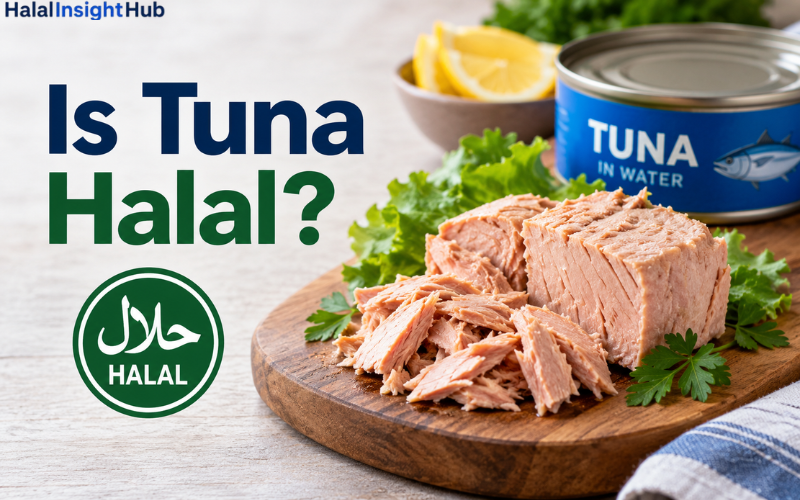
Is tuna halal or haram? Yes, tuna is halal in Islam. Tuna is a type of fish, and fish is generally considered permissible to eat according to Islamic dietary laws. The four major Sunni schools of thought accept fish as halal, although there are some differences regarding other types of seafood.
Whether you are eating fresh tuna, canned tuna, grilled tuna, or tuna sushi, the tuna itself is halal. However, processed tuna products can contain additional ingredients that may require checking before eating.
Quick Answer
Yes — tuna is halal for Muslims. 🐟
Tuna is a fish, and fish is widely accepted as halal in Islamic law. Unlike land animals, fish do not require slaughter according to the traditional Islamic slaughter method.
The main thing to check is how the tuna is prepared. Plain tuna is halal, but sauces, seasonings, marinades, mayonnaise, or other added ingredients could affect the halal status of a prepared tuna dish.
Tuna Halal Status at a Glance
| Question | Answer |
| Is tuna halal? | ✅ Yes |
| Is fresh tuna halal? | ✅ Yes |
| Is canned tuna halal? | ✅ Usually, if the ingredients are halal |
| Is raw tuna halal? | ✅ Yes, if safe and prepared with halal ingredients |
| Does tuna need halal slaughter? | ❌ No |
| Is tuna halal in all four Sunni schools? | ✅ Yes |
What Is Tuna?
Tuna is a large saltwater fish belonging to the mackerel family. It is one of the most popular seafood products in the world and is commonly sold fresh, frozen, canned, or prepared as part of restaurant meals.
Tuna is used in many different dishes, including:
- Tuna sandwiches
- Tuna salad
- Grilled tuna steaks
- Canned tuna
- Tuna sushi
- Tuna pasta
- Tuna wraps
- Tuna burgers
Because tuna is a fish, its basic halal status is straightforward. The more important question often becomes what other ingredients are added to the tuna.
What Does Islam Say About Eating Fish?
Islam permits seafood, and fish are widely recognized as halal.
Allah says in the Quran:
“Lawful to you is game from the sea and its food as provision for you and the travelers.”
Surah Al-Ma’idah 5:96
This verse is among the primary evidences used by Islamic scholars when discussing the permissibility of seafood.
Fish such as tuna fall clearly within this category.
Related Post: Is Root Beer Halal or Haram for Muslims?
Is Tuna Halal According to the Hanafi School?
Yes, tuna is halal according to the Hanafi school.
The Hanafi school has traditionally discussed seafood somewhat differently from the other Sunni schools. Hanafi scholars generally consider fish permissible while having different rulings regarding some other sea creatures.
Tuna is unquestionably a fish, so it does not create the same classification question that can arise with animals such as crab, lobster, or other shellfish.
Therefore, Muslims who follow the Hanafi school can eat tuna.
Is Tuna Halal According to the Shafi’i School?
Yes. Tuna is halal according to the Shafi’i school.
The Shafi’i school generally permits seafood, and tuna is a conventional fish that falls within this category.
Fresh tuna, cooked tuna, and properly prepared canned tuna can therefore be consumed as halal, provided no haram ingredients have been added.
Is Tuna Halal According to the Maliki School?
Yes, tuna is halal according to the Maliki school.
The Maliki school has a broad approach to seafood and generally permits creatures from the sea.
Since tuna is a fish, there is no significant concern about its basic permissibility.
Is Tuna Halal According to the Hanbali School?
Yes. Tuna is halal according to the Hanbali school.
Fish are considered permissible, and tuna falls directly within this category.
This means there is broad agreement among the four major Sunni schools that tuna itself is halal.
Tuna and the Four Sunni Schools
| Islamic School | Ruling on Tuna | Explanation |
| Hanafi | ✅ Halal | Tuna is clearly classified as fish |
| Shafi’i | ✅ Halal | Seafood is generally permissible |
| Maliki | ✅ Halal | Sea animals are broadly permissible |
| Hanbali | ✅ Halal | Fish are permissible |
Does Tuna Need to Be Slaughtered?
No, tuna does not need to be slaughtered in the same way as land animals.
Islamic slaughter requirements apply to relevant land animals. Fish are different because they are aquatic animals.
A fish can therefore be caught and eaten without performing traditional dhabihah.
This is one reason fish is considered a convenient halal source of protein for Muslims.
Is Canned Tuna Halal?
Yes, plain canned tuna is generally halal.
Canned tuna usually contains tuna, water or oil, and salt. These ingredients are normally halal.
However, flavored or seasoned tuna products can contain additional ingredients, so Muslims should check the label when necessary.
For example, canned tuna may contain:
- Tuna
- Water
- Vegetable oil
- Salt
- Spices
- Mayonnaise
- Flavorings
- Preservatives
Most of these ingredients are halal, but some processed ingredients may require further verification.
Canned Tuna: What Should You Check?
| Product Type | General Status | What to Check |
| Plain canned tuna | ✅ Halal | Basic ingredients |
| Tuna in water | ✅ Halal | Added ingredients |
| Tuna in vegetable oil | ✅ Halal | Oil and additives |
| Flavored tuna | ⚠️ Check ingredients | Flavorings and sauces |
| Tuna salad | ⚠️ Check ingredients | Mayonnaise and dressings |
| Tuna sandwich | ⚠️ Check ingredients | Bread, sauces, cheese |
Is Raw Tuna Halal?
Yes, raw tuna is halal because tuna itself is a halal fish.
Raw tuna is commonly used in sushi, sashimi, and other dishes.
However, Muslims should distinguish between the fish itself and the complete dish.
For example, raw tuna served by itself is halal. But sushi may contain additional ingredients such as:
- Alcohol-based sauces
- Mirin
- Non-halal sauces
- Unverified mayonnaise
- Other questionable ingredients
Therefore, Muslims should check the complete dish rather than assuming every tuna-based meal is automatically halal.
Is Tuna Sushi Halal?
Tuna sushi can be halal, but it depends on the ingredients used.
Plain tuna sushi containing rice, tuna, seaweed, and halal seasonings is generally permissible.
The concern is usually not the tuna. Instead, it can be the sauces or additional ingredients.
Before ordering tuna sushi, ask whether the restaurant uses:
- Mirin or cooking alcohol
- Alcohol-containing sauces
- Non-halal mayonnaise
- Unverified flavorings
- Shared preparation surfaces
If all ingredients are halal and there is no significant cross-contamination concern, tuna sushi can be enjoyed by Muslims.
Is Tuna Salad Halal?
Tuna salad can be halal, but its status depends on what is added to it.
A simple tuna salad made from tuna, vegetables, and halal mayonnaise is generally permissible.
However, Muslims should check the mayonnaise and dressing when eating tuna salad outside the home.
Common ingredients to consider include:
- Mayonnaise
- Mustard
- Salad dressing
- Cheese
- Flavorings
- Vinegar
If these ingredients are halal, the tuna salad remains halal.
Is Grilled Tuna Halal?
Yes, grilled tuna is halal.
Grilling does not change the halal status of tuna. The main concern is the ingredients used during preparation.
For example, grilled tuna can become questionable if it is marinated with alcohol or cooked using a sauce containing a haram ingredient.
At a restaurant, it is reasonable to ask about the marinade and cooking sauce before ordering.
Is Tuna Halal at Restaurants?
Tuna itself is halal, but restaurant preparation can introduce additional concerns.
When ordering tuna at a restaurant, Muslims should consider:
- Ingredients — Are the sauces and marinades halal?
- Cooking methods — Is the tuna cooked with alcohol?
- Cross-contamination — Is the same equipment used for non-halal foods?
- Sauces — Do dressings or flavorings contain questionable ingredients?
A restaurant does not necessarily need to be fully halal for plain tuna to be permissible. However, Muslims who are particularly cautious about cross-contamination should ask about preparation methods.
Health Benefits of Tuna
Tuna is also a nutrient-rich food and is commonly included in balanced diets.
It provides:
- High-quality protein
- Omega-3 fatty acids
- Vitamin B12
- Selenium
- Niacin
- Phosphorus
Protein helps support muscle maintenance, while nutrients such as vitamin B12 and selenium play important roles in normal body functions.
However, tuna consumption should still be balanced. Certain types of tuna can contain higher levels of mercury, so following appropriate dietary guidance is important, particularly for pregnant people and young children.
Tuna Nutrition at a Glance
| Nutrient | Why It Matters |
| Protein | Supports muscles and tissue maintenance |
| Omega-3 fatty acids | Important for heart and brain health |
| Vitamin B12 | Supports normal nerve and blood function |
| Selenium | Helps protect cells from oxidative stress |
| Niacin | Supports normal energy metabolism |
| Phosphorus | Important for bones and normal cell function |
How to Make Sure Your Tuna Is Halal
If you want to keep your tuna meal clearly halal, follow a few simple steps.
Choose Plain Tuna
Plain fresh or canned tuna is usually the easiest option because it contains fewer additional ingredients.
Read the Ingredient Label
For processed tuna, check sauces, flavorings, marinades, and other additives.
Check Restaurant Sauces
If you order tuna outside, ask whether the sauce or marinade contains alcohol or other non-halal ingredients.
Look for Halal Certification
For processed tuna products, halal certification can provide additional reassurance.
Ask When You Are Unsure
If an ingredient is unclear, asking the manufacturer or restaurant is better than making assumptions.
Can Muslims Eat Tuna Every Day?
Tuna is halal, but that does not necessarily mean it should be eaten every day.
Different types of tuna contain different levels of mercury, and dietary guidance generally recommends varying seafood choices rather than relying heavily on one type.
A balanced diet can include tuna alongside other halal fish, seafood, vegetables, grains, fruits, and other nutritious foods.
“I hope you learned a lot from this article. Check out more articles like this.”
- Is Root Beer Halal or Haram for Muslims?
- Is Pork Halal or Haram for Muslims?
- Is Crab Halal or Haram for Muslims?
- Is Tyson Chicken Halal or Haram for Muslims?
- Is Swedish Fish Halal or Haram for Muslims?
FAQs
Is tuna halal in Islam?
Yes. Tuna is a fish and is considered halal by the four major Sunni schools of Islamic jurisprudence.
Is canned tuna halal?
Plain canned tuna is generally halal. However, flavored or seasoned products should be checked for additional ingredients.
Is tuna halal for Hanafis?
Yes. Tuna is clearly a fish, so it is permissible according to the Hanafi school.
Does tuna need to be slaughtered?
No. Fish do not require traditional Islamic slaughter in the same way that land animals do.
Is raw tuna halal?
Yes. Raw tuna is halal, provided the other ingredients and preparation methods used in the dish are halal.
Is tuna sushi halal?
Tuna sushi can be halal if all ingredients are halal. Muslims should check sauces, marinades, mirin, and other added ingredients.
Is tuna salad halal?
Tuna salad can be halal. Check mayonnaise, dressings, seasonings, and any other added ingredients.
Is grilled tuna halal?
Yes. Grilled tuna is halal as long as the marinade, sauces, and other ingredients used during preparation are halal.
Is tuna halal in all four Sunni schools?
Yes. Tuna is considered halal across the Hanafi, Shafi’i, Maliki, and Hanbali schools because it is a fish.
Related Post: Is Pork Halal or Haram for Muslims?
Conclusion
Tuna is halal in Islam. There is broad agreement among the four major Sunni schools that tuna, as a type of fish, is permissible for Muslims to eat.
Fresh tuna, canned tuna, grilled tuna, and raw tuna can all be halal. The main issue is not the tuna itself but the ingredients and preparation methods used with it. Sauces, marinades, mayonnaise, flavorings, and other processed ingredients should be checked when their halal status is uncertain.
For the simplest and safest choice, plain tuna with clearly halal ingredients is an excellent option. When eating tuna at a restaurant or buying a processed product, checking the ingredient list or asking about preparation can help you avoid doubtful ingredients.
In short, Muslims can eat tuna without concern about the fish itself, as long as the complete meal is prepared with halal ingredients and according to Islamic dietary principles.


Pingback: Is Mirin Halal or Haram for Muslims? -
Pingback: Is Jello Halal or Haram? -