
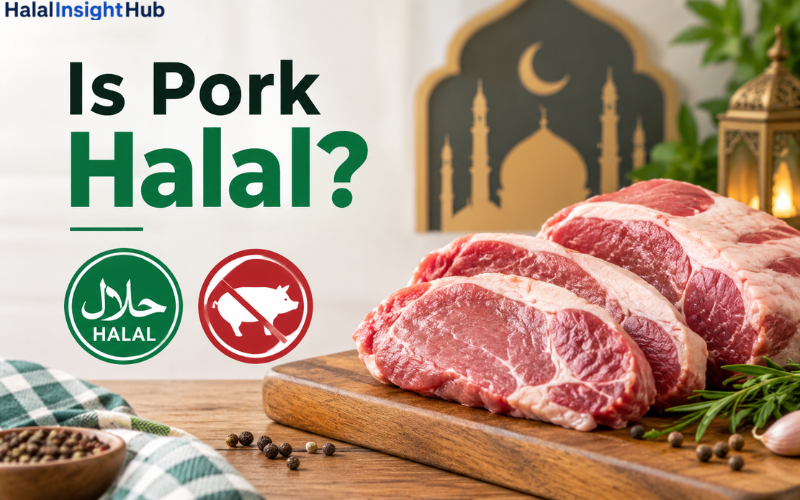
Is pork halal in Islam? Learn what the Quran and Hadith say about pork, why Muslims cannot eat it, which pork products to avoid, and how to identify hidden pork ingredients.
No, pork is haram in Islam. The Quran explicitly prohibits pork, and Muslims are not permitted to eat pork meat or knowingly consume food made from pork-derived ingredients.
The prohibition applies to pork from pigs as well as many ingredients derived from pigs, including pork fat and certain forms of gelatin. Muslims should therefore check food labels carefully, especially when buying processed foods, candies, desserts, or packaged products.
If you are wondering “Is pork halal?”, the simple answer is no. Pork is one of the foods explicitly prohibited in Islamic dietary law.
Quick Answer
No, pork is not halal. Pork is haram according to the Quran and Islamic dietary law.
Allah explicitly prohibits swine flesh in the Quran, and this prohibition is understood by Muslim scholars across the major schools of Islamic jurisprudence. This includes pork meat itself and, depending on the ingredient, products derived from pigs.
So Muslims should avoid foods containing pork, pork fat, bacon, ham, lard, and other clearly pork-derived ingredients.
If a packaged food contains an unfamiliar animal-derived ingredient, checking the ingredient label or looking for reliable halal certification can help determine whether it is suitable for Muslims.
Pork Halal Status at a Glance
| Question | Answer |
| Is pork halal? | ❌ No, pork is haram |
| Does the Quran prohibit pork? | ✅ Yes |
| Can Muslims eat pork meat? | ❌ No |
| Is bacon halal? | ❌ No, when it is pork bacon |
| Is ham halal? | ❌ Pork ham is haram |
| Is lard halal? | ❌ Pork lard is haram |
| Is pork gelatin halal? | ❌ Pork-derived gelatin is not halal |
| Can Muslims eat pork accidentally? | Accidental consumption is treated differently from knowingly eating it |
What Does the Quran Say About Pork?
The prohibition of pork is clearly mentioned in the Quran.
Allah says:
“He has only forbidden to you dead animals, blood, the flesh of swine…”
Quran 2:173
A similar prohibition appears in several other verses, including Quran 5:3, 6:145, and 16:115.
These verses establish that swine flesh is forbidden for Muslims.
Because the prohibition is stated explicitly in the Quran, pork is not considered a matter of ordinary scholarly disagreement like some other food-related questions.
Related Post: Is Crab Halal or Haram for Muslims?
Why Is Pork Haram in Islam?
The primary reason Muslims avoid pork is that Allah has explicitly prohibited it.
Islamic dietary rules are based on revelation, and Muslims follow these rules as part of their faith and obedience to Allah.
The Quran does not require Muslims to independently discover a scientific reason before accepting a dietary prohibition. Therefore, even when different explanations are discussed, the fundamental reason pork is haram is its explicit prohibition in Islamic revelation.
Some discussions also mention possible health or hygiene concerns associated with pork, but these should not be confused with the actual basis of the Islamic ruling.
The religious ruling comes from the Quran and Sunnah.
Is All Pork Haram?
Yes. Pork meat itself is prohibited.
This includes commonly recognized pork products such as:
- Pork chops
- Pork ribs
- Pork belly
- Pork sausage
- Bacon made from pork
- Pork ham
- Pork tenderloin
- Pulled pork
- Pork-based meatballs
A product does not become halal simply because it is processed, seasoned, smoked, or cooked differently.
For example, pork bacon remains haram even after it has been smoked or heavily seasoned.
Common Pork Products Muslims Should Avoid
| Product | Halal Status | Explanation |
| Pork meat | ❌ Haram | Directly derived from pig |
| Pork bacon | ❌ Haram | Made from pork |
| Pork ham | ❌ Haram | Usually made from pork |
| Pork sausage | ❌ Haram | When made from pork |
| Lard | ❌ Haram | Pork-derived fat |
| Pork gelatin | ❌ Haram | Derived from pig collagen |
| Pork pepperoni | ❌ Haram | Pork-based processed meat |
Muslims should also be careful with products that do not obviously contain the word “pork” but may contain pork-derived ingredients.
Is Bacon Halal?
Traditional pork bacon is not halal.
Bacon is commonly made from pork belly or other cuts of pork. Since pork is prohibited in Islam, pork bacon is also prohibited.
However, the word “bacon” does not always mean pork.
Some manufacturers produce bacon from:
- Beef
- Turkey
- Chicken
These alternatives may be halal if the animal and production process meet Islamic dietary requirements.
Therefore, Muslims should not judge a product only by the word “bacon.” Check the ingredients and halal certification.
Is Ham Halal?
Traditional pork ham is haram because it comes from pigs.
Ham is commonly produced by curing, smoking, or processing pork. Changing the preparation method does not change the basic source of the meat.
However, some products marketed as “turkey ham” or “beef ham” are made from different animals. These products may be halal if the ingredients, slaughter method, and manufacturing process comply with Islamic requirements.
Always check for halal certification when buying processed meat.
Is Lard Halal?
No. Pork lard is haram.
Lard is a type of animal fat traditionally obtained from pigs. It can be used in cooking, baking, pastries, fried foods, and processed products.
This makes ingredient checking particularly important.
A product may not contain visible pieces of pork but can still contain pork-derived fat.
Muslims should therefore look for ingredients such as:
- Lard
- Pork fat
- Pork shortening
- Pig fat
If the source is unclear, check with the manufacturer or choose a halal-certified alternative.
Is Pork Gelatin Halal?
Pork-derived gelatin is not considered halal.
Gelatin is produced from collagen found in animal tissues, and the source can vary. Some gelatin is made from:
- Pork
- Beef
- Fish
If gelatin comes from pork, it is not halal.
Beef gelatin is not automatically halal either because the animal and slaughter process must meet Islamic requirements. Fish gelatin can be halal depending on the specific product and ingredients.
For this reason, halal certification can be particularly useful when buying foods containing gelatin.
Foods That May Contain Hidden Pork Ingredients
Pork is not always obvious from the product name.
Some processed foods may contain pork-derived ingredients or additives.
| Food Category | Possible Concern | What to Check |
| Candy | Gelatin | Source of gelatin |
| Marshmallows | Gelatin | Pork or halal gelatin |
| Pastries | Lard/shortening | Type of fat used |
| Processed meat | Pork ingredients | Meat source |
| Instant noodles | Pork flavoring | Flavoring ingredients |
| Sauces | Meat extracts | Animal-derived ingredients |
| Capsules | Gelatin | Capsule source |
This does not mean every product in these categories contains pork. The important point is to check the ingredients rather than assume.
Is Pork Flavoring Halal?
A product described as having “pork flavor” or “bacon flavor” requires careful checking.
If the flavoring contains actual pork-derived ingredients, it is not halal.
However, some products use artificial or plant-based flavoring designed to imitate pork or bacon. The ruling can depend on the ingredients and manufacturing process.
Muslims should therefore check the product label and halal certification instead of assuming that every “bacon-flavored” product contains actual pork.
Can Muslims Eat Food Cooked With Pork?
No. Muslims should not knowingly consume food that contains pork or pork-derived ingredients.
For example, if vegetables are cooked together with pork, the dish should not simply be considered halal because the vegetables themselves are naturally permissible.
Cross-contact is also an important consideration, especially in restaurants.
Muslims who follow strict halal practices may ask whether:
- The same cooking oil is used for pork
- The same grill is used
- The same utensils are used
- Food is stored together
- Separate preparation areas are available
The exact level of precaution can vary according to individual religious guidance.
Is Pork Haram Even If It Is Cooked?
Yes.
Cooking pork does not make it halal.
The prohibition is related to the food itself, not whether the pork is raw, fried, grilled, baked, roasted, or boiled.
For example:
- Raw pork → Haram
- Fried pork → Haram
- Grilled pork → Haram
- Smoked pork → Haram
- Boiled pork → Haram
Changing the cooking method does not change the Islamic ruling.
Is Pork Haram in All Forms?
The Quran explicitly prohibits swine flesh. Islamic scholars also discuss derivatives and ingredients made from pigs, such as pork fat and pork-derived gelatin.
For everyday food choices, Muslims should therefore avoid clearly pork-derived ingredients and products.
When an ingredient has undergone significant processing and its source or transformation is disputed, the matter can become more detailed in Islamic jurisprudence. In such cases, Muslims may consult a qualified scholar or rely on a reputable halal certification authority.
What If Someone Eats Pork by Mistake?
Accidental consumption is different from knowingly choosing to eat prohibited food.
For example, a person may eat something believing it contains halal meat and later discover that it contained pork. That situation is not the same as deliberately ordering and eating pork.
The Quran provides an exception for situations involving genuine necessity:
“But whoever is forced by necessity, neither desiring it nor transgressing its limit, there is no sin upon him.”
Quran 2:173
This exception concerns genuine necessity, not ordinary convenience or preference.
If someone accidentally consumes pork, they should not panic. They can stop eating it once they discover what it is and seek guidance if they have specific religious concerns.
How to Avoid Pork as a Muslim
Avoiding pork is usually straightforward when buying fresh food, but processed foods require more attention.
Here are some practical steps:
1. Read the Ingredient Label
Look for words such as:
- Pork
- Bacon
- Ham
- Lard
- Pork fat
- Pork gelatin
- Porcine gelatin
- Pork extract
2. Look for Halal Certification
A trusted halal certification mark can make it easier to identify suitable processed foods.
3. Ask Restaurants
When eating outside, ask whether the restaurant uses pork and whether your food is prepared separately.
4. Be Careful With Processed Foods
Candy, desserts, sauces, instant meals, and processed meats can contain animal-derived ingredients that are not immediately obvious.
5. Check the Source of Gelatin
Do not assume that “gelatin” automatically means halal. Check whether it comes from pork, halal-certified beef, or another source.
Pork vs Halal Meat
| Feature | Pork | Halal Meat |
| Animal source | Pig | Permissible animal |
| Islamic status | ❌ Haram | ✅ Halal when requirements are met |
| Can Muslims eat it? | ❌ No | ✅ Yes |
| Requires halal slaughter? | Not applicable because pork itself is prohibited | ✅ Yes for applicable land animals |
| Common examples | Pork, ham, bacon | Halal beef, chicken, lamb |
The key difference is that pigs are prohibited as a food source in Islamic dietary law, while permissible land animals can be halal when slaughtered according to Islamic requirements.
How to Identify Pork on Food Labels
Food labels can sometimes be confusing, especially when products are imported from different countries.
Common terms associated with pork include:
- Pork
- Porcine
- Lard
- Pork fat
- Pork stock
- Pork extract
- Bacon
- Ham
- Prosciutto
- Pepperoni, when pork-based
However, not every unfamiliar ingredient is automatically haram.
For example, an ingredient may have an animal-derived source that requires further verification. When in doubt, check the manufacturer’s information or look for reliable halal certification.
“I hope you learned a lot from this article. Check out more articles like this.”
- Is Crab Halal or Haram for Muslims?
- Is Shrimp Halal or Haram for Muslims
- Is Tyson Chicken Halal or Haram for Muslims?
- Is Swedish Fish Halal or Haram for Muslims?
- Is Jollibee Halal or Haram for Muslims?
FAQs
Is pork halal in Islam?
No. Pork is explicitly prohibited in Islam and is considered haram.
Is bacon halal?
Traditional pork bacon is not halal. Turkey or beef bacon may be halal if it meets Islamic dietary requirements.
Is ham halal?
Traditional pork ham is haram. Products made from halal-certified beef or turkey may be permissible depending on their ingredients and preparation.
Is pork gelatin halal?
No. Gelatin derived from pigs is not halal.
Is lard halal?
Pork lard is haram because it is derived from pigs.
Does cooking pork make it halal?
No. Cooking, frying, grilling, or smoking pork does not change its Islamic status.
What does the Quran say about pork?
The Quran explicitly prohibits swine flesh in verses including Quran 2:173, 5:3, 6:145, and 16:115.
Can Muslims eat turkey bacon?
Turkey bacon can be halal if the turkey is permissible, slaughtered according to Islamic requirements where applicable, and the product contains no other prohibited ingredients.
Is pork flavoring haram?
It depends on the ingredients. If the flavoring contains pork-derived substances, it is not halal. Artificial flavoring without prohibited ingredients may require separate evaluation.
What should I do if I accidentally eat pork?
Accidentally consuming pork is different from deliberately eating it. Once you discover that the food contains pork, stop consuming it and, if needed, seek guidance from a qualified Islamic scholar.
Related Post: Is Shrimp Halal or Haram for Muslims?
Conclusion
Pork is not halal in Islam; it is explicitly haram. The Quran clearly prohibits swine flesh, making pork one of the foods that Muslims are required to avoid.
The prohibition applies to common pork products such as bacon, ham, pork sausage, and lard. Muslims should also pay attention to processed ingredients such as pork-derived gelatin and other substances made from pigs.
At the same time, not every product with an unfamiliar ingredient is automatically haram. Checking the ingredient list, looking for reliable halal certification, and asking manufacturers or restaurants when necessary can help Muslims make informed food choices.
For everyday shopping, the simplest approach is to avoid clearly pork-derived ingredients and choose products with trustworthy halal certification when there is uncertainty.
In short: pork is haram, and Muslims should not knowingly consume pork or clearly pork-derived food products.

Pingback: Is Root Beer Halal or Haram for Muslims? -
Pingback: Is Tuna Halal or Haram for Muslims? -
Pingback: Is Dr Pepper Halal or Haram for Muslims? -