
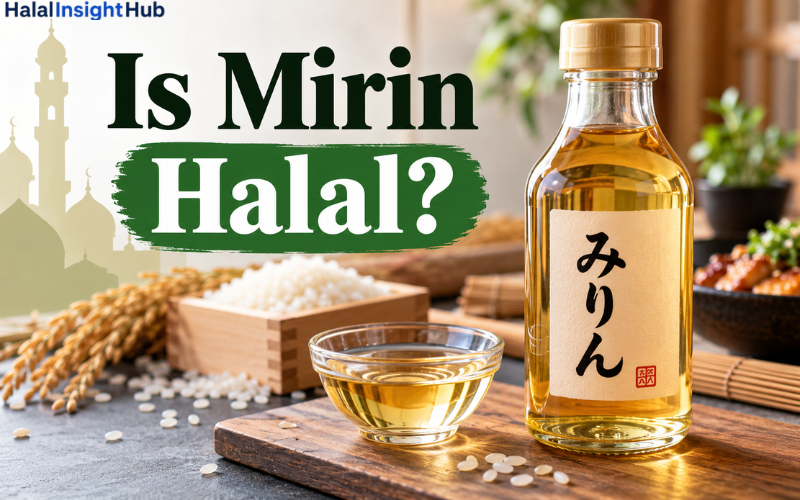
Is Mirin halal or haram? No, Traditional mirin is generally not considered halal because it is a Japanese cooking seasoning that contains alcohol. Authentic mirin is made using ingredients such as fermented rice, rice koji, and shochu or another distilled alcohol, giving it a noticeable alcohol content.
However, not every product labeled “mirin” is exactly the same. Some supermarkets sell mirin-style seasonings, mirin-like sauces, or alcohol-free alternatives that may not contain alcohol. Their halal status depends on the ingredients and manufacturing process.
For Muslims, the safest approach is to check the ingredient label and look for halal certification before using mirin in food.
Quick Answer
Traditional mirin is generally not halal because it contains alcohol.
However, alcohol-free mirin substitutes may be halal if they contain only permissible ingredients and do not include other haram substances.
| Product | General Halal Status | Why? |
| Traditional mirin | ❌ Generally not halal | Contains alcohol |
| Hon mirin | ❌ Generally not halal | Contains significant alcohol |
| Mirin-style seasoning | ⚠️ Check ingredients | Formulas vary |
| Alcohol-free mirin | ✅ Potentially halal | Depends on ingredients |
| Halal-certified mirin substitute | ✅ Halal | Certified for Muslim consumers |
What Is Mirin?
Mirin is a traditional Japanese seasoning commonly used in Japanese cooking. It has a sweet taste and is often added to sauces, marinades, soups, and glazes.
It is especially common in dishes such as:
- Teriyaki sauce
- Japanese soups
- Stir-fries
- Sushi sauces
- Marinades
- Glazes
- Japanese noodle dishes
Mirin is valued because it adds sweetness, depth, and a glossy finish to food.
Unlike ordinary sugar or vinegar, traditional mirin is produced through fermentation and commonly contains alcohol.
This alcohol content is the main reason Muslims need to pay attention to the type of mirin they are buying.
Does Mirin Contain Alcohol?
Yes, traditional mirin contains alcohol.
Authentic mirin, often called hon mirin, is an alcoholic Japanese seasoning. Its alcohol content is generally around 14% ABV, although the exact amount can vary between products.
The alcohol is an important part of traditional mirin production and contributes to its flavor.
This creates an important distinction between traditional mirin and products marketed as:
- Mirin-style seasoning
- Mirin seasoning
- Mirin-like sauce
- Alcohol-free mirin
- Halal mirin substitute
These products can have very different formulations.
Why Is Traditional Mirin Not Halal?
From an Islamic dietary perspective, intoxicating alcoholic beverages are prohibited.
Traditional mirin is deliberately produced as an alcoholic seasoning and contains a substantial amount of alcohol. Therefore, Muslims who follow the stricter and widely accepted approach to avoiding intoxicating alcohol should not consume traditional mirin.
The important issue is not simply that mirin is used for cooking. The concern is that authentic mirin itself is an alcoholic product.
For this reason, traditional mirin should not automatically be treated like ingredients where only trace amounts of naturally occurring alcohol may be present.
Is Hon Mirin Halal?
Generally, no.
Hon mirin is the traditional form of Japanese mirin and normally contains alcohol. It is produced using fermented rice, koji, and distilled alcohol.
Because alcohol is intentionally present in the finished product, Muslims should generally avoid hon mirin unless a reliable halal authority has specifically certified a particular product.
Always check the product label because formulations can differ.
Related Post: Is Tuna Halal or Haram for Muslims?
Is Mirin-Style Seasoning Halal?
Mirin-style seasoning is different from traditional mirin.
Some manufacturers produce mirin-style products without the same level of alcohol found in authentic mirin. Others may still contain alcohol or alcohol-derived ingredients.
Therefore, there is no universal ruling for every mirin-style seasoning.
Before buying one, check:
- The ingredient list
- Alcohol or ethanol content
- Halal certification
- Manufacturer information
- Any flavorings or additives
If the product is halal-certified, it is the simplest option for Muslim consumers.
Traditional Mirin vs. Mirin-Style Seasoning
| Feature | Traditional Mirin | Mirin-Style Seasoning |
| Alcohol | Usually contains alcohol | May or may not contain alcohol |
| Taste | Sweet and rich | Designed to imitate mirin |
| Production | Traditional fermentation process | Varies by manufacturer |
| Halal status | Generally not halal | Must be checked |
| Muslim-friendly option | Usually avoid | Choose halal-certified products |
Is Cooking With Mirin Halal?
Cooking with traditional mirin does not automatically make it halal simply because the food is heated.
Some people believe that cooking causes the alcohol to disappear completely. However, the amount of alcohol that remains after cooking can depend on factors such as cooking time, temperature, recipe, and preparation method.
More importantly, traditional mirin is intentionally manufactured as an alcoholic product.
Therefore, Muslims who want to avoid haram alcohol should not rely on cooking alone as a reason to consider traditional mirin halal.
A better option is to use a halal-certified or alcohol-free substitute.
Does Cooking Remove Alcohol From Mirin?
Cooking can reduce the amount of alcohol in a dish, but it does not necessarily remove all of it.
The amount remaining depends on several factors, including:
- Cooking temperature
- Cooking duration
- Quantity of mirin used
- Cooking method
- Whether the dish is covered
Because complete removal cannot simply be assumed, cooking traditional mirin should not be considered a guaranteed way to make it halal.
For Muslims who want to avoid alcoholic ingredients, choosing an alcohol-free alternative is a much safer approach.
Is Mirin Halal According to Islamic Scholars?
The basic Islamic principle is that intoxicating alcoholic drinks are prohibited.
Allah says:
“O you who have believed, indeed, intoxicants, gambling, [sacrificing on] stone alters [to other than Allah], and divining arrows are but defilement from the work of Satan, so avoid it that you may be successful.”
Quran 5:90
The Prophet Muhammad ﷺ also said:
“Every intoxicant is khamr, and every intoxicant is forbidden.”
This principle is why Muslims need to distinguish between naturally occurring trace alcohol and products that are intentionally manufactured as alcoholic beverages or alcoholic ingredients.
Traditional mirin falls into the latter category.
Can Muslims Eat Food Made With Mirin?
If the food is prepared using traditional alcoholic mirin, Muslims who follow the standard precautionary ruling regarding alcohol should avoid it.
However, food prepared with an alcohol-free, halal-certified mirin substitute can be permissible if all other ingredients are halal.
This is particularly important when eating Japanese food at restaurants.
For example, a teriyaki sauce may contain:
- Soy sauce
- Sugar
- Mirin
- Sake
- Flavorings
Even if the chicken or seafood itself is halal, the sauce may contain non-halal ingredients.
Therefore, Muslims should check the sauce as well as the main food.
Is Teriyaki Sauce With Mirin Halal?
Not necessarily.
Traditional Japanese teriyaki sauce often includes mirin and sometimes sake. If those alcoholic ingredients are present, the sauce may not be suitable for Muslims.
However, many modern teriyaki sauces use substitutes instead of traditional mirin or sake.
When buying packaged teriyaki sauce, check the ingredient label for:
- Mirin
- Hon mirin
- Sake
- Alcohol
- Ethanol
- Cooking wine
A halal certification mark provides additional confidence.
Halal Alternatives to Mirin
Muslims do not need to give up Japanese-style recipes simply because traditional mirin is not suitable.
Several alternatives can provide sweetness and depth without traditional alcoholic mirin.
Common options include:
- Rice vinegar with sugar
- Apple juice
- White grape juice
- Halal-certified mirin-style seasoning
- Alcohol-free Japanese seasoning
- Sugar and rice vinegar mixture
The best substitute depends on the recipe.
For a simple homemade alternative, a small amount of rice vinegar combined with sugar can provide some of the sweet-and-acidic balance that mirin contributes to a dish.
Mirin Alternatives for Muslim Consumers
| Alternative | Halal-Friendly? | Best Use |
| Rice vinegar + sugar | ✅ Generally | Sauces and marinades |
| Apple juice | ✅ Generally | Sweet sauces and glazes |
| White grape juice | ✅ Generally | Marinades and sauces |
| Alcohol-free mirin | ✅ If ingredients are halal | Japanese recipes |
| Halal-certified mirin substitute | ✅ Yes | Direct mirin replacement |
How to Check If Mirin Is Halal
If you are unsure about a particular product, follow these steps.
1. Read the Ingredient Label
Look for words such as:
- Alcohol
- Ethanol
- Sake
- Shochu
- Cooking wine
- Hon mirin
If traditional alcohol is listed, the product should generally be avoided by Muslims who follow the prohibition of alcoholic ingredients.
2. Look for Halal Certification
A recognized halal certification logo can make the decision much easier.
3. Check the Alcohol Percentage
If a product contains a meaningful percentage of alcohol, it should not be assumed halal simply because it is sold as a cooking ingredient.
4. Contact the Manufacturer
If the label is unclear, contact the manufacturer and ask about the source and processing of the ingredients.
Is Alcohol-Free Mirin Halal?
Alcohol-free mirin can be halal, but “alcohol-free” alone does not automatically guarantee halal status.
The complete ingredient list still matters.
For example, a product could be alcohol-free but contain another questionable ingredient. Conversely, a product made entirely from permissible ingredients may be suitable for Muslims.
The best option is an alcohol-free product that also carries reliable halal certification.
Can Muslims Use Mirin Substitute?
Yes. Muslims can use a halal mirin substitute as long as its ingredients and production process comply with halal requirements.
This is often the easiest way to prepare Japanese recipes while avoiding traditional alcoholic mirin.
When shopping, look for products specifically labeled:
“Halal Certified” or “Alcohol-Free.”
If both are available, a halal-certified product is preferable because it provides additional assurance.
Is Mirin Vinegar Halal?
Mirin vinegar is not necessarily the same as traditional mirin.
Some products may be made from fermented ingredients without containing significant alcohol in the final product, while others can have different formulations.
Therefore, the name alone is not enough to determine whether a product is halal.
Check the ingredients and certification before using it.
“I hope you learned a lot from this article. Check out more articles like this.”
- Is Tuna Halal or Haram for Muslims?
- Is Root Beer Halal or Haram for Muslims?
- Is Crab Halal or Haram for Muslims?
- Is Tyson Chicken Halal or Haram for Muslims?
- Is Swedish Fish Halal or Haram for Muslims?
FAQs
Is mirin halal in Islam?
Traditional mirin is generally not considered halal because it contains alcohol. Alcohol-free and halal-certified alternatives may be permissible.
Does mirin contain alcohol?
Yes. Traditional mirin, especially hon mirin, normally contains a significant amount of alcohol.
Is hon mirin halal?
Generally, no. Hon mirin is an alcoholic Japanese cooking seasoning and should generally be avoided by Muslims.
Is mirin seasoning halal?
It depends on the product. Some mirin seasonings contain alcohol, while others are alcohol-free. Always check the ingredients and halal certification.
Is cooking with mirin haram?
If traditional alcoholic mirin is used, Muslims who avoid alcoholic ingredients should generally avoid the dish. Cooking does not guarantee that all alcohol has disappeared.
Is teriyaki sauce halal if it contains mirin?
Traditional teriyaki sauce containing alcoholic mirin is generally not suitable for Muslims who avoid alcohol. However, halal teriyaki sauces made without prohibited ingredients can be permissible.
What can Muslims use instead of mirin?
Muslims can use halal-certified mirin substitutes, rice vinegar mixed with sugar, apple juice, or white grape juice depending on the recipe.
Is alcohol-free mirin halal?
It can be halal if its ingredients are permissible. A reliable halal certification provides the strongest assurance.
Related Post: Is Root Beer Halal or Haram for Muslims?
Conclusion
So, is mirin halal? Traditional mirin is generally not halal for Muslims because it is an alcoholic Japanese seasoning and commonly contains a significant amount of alcohol.
However, the word “mirin” does not always describe the same type of product. Mirin-style seasonings and alcohol-free alternatives can have completely different ingredients and may be suitable for Muslims.
The safest choice is to check the ingredient label and look for reliable halal certification. If traditional hon mirin, sake, shochu, or alcohol is listed, it is better to choose a halal alternative.
Fortunately, Muslims can still enjoy Japanese-inspired dishes without traditional mirin. Rice vinegar with sugar, fruit juices, and halal-certified mirin substitutes can provide similar sweetness and depth while making it easier to follow halal dietary guidelines.
When in doubt, choose a clearly halal-certified alternative rather than relying on assumptions about how much alcohol remains after cooking.


Pingback: Is Jello Halal or Haram? -