
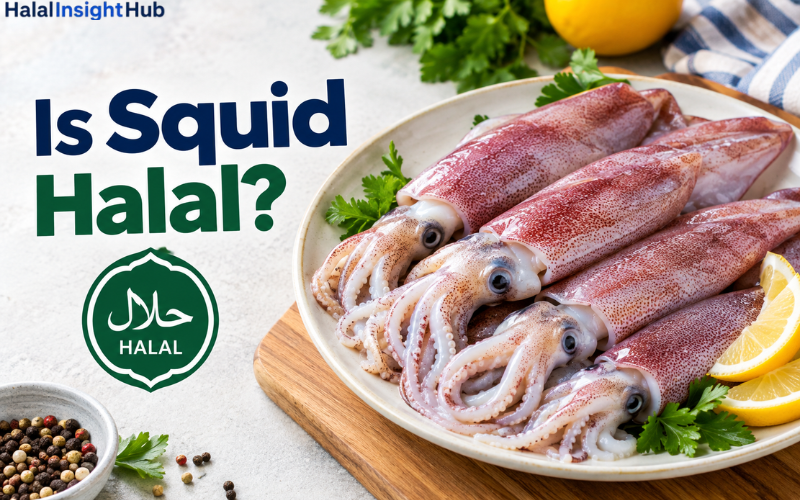
Is squid halal or haram? Yes, squid is considered halal by the majority of Islamic scholars, including scholars from the Shafi’i, Maliki, and Hanbali schools. However, the Hanafi school has a more restrictive approach to seafood, and some Hanafi scholars do not consider squid permissible because it is not classified as a fish.
Therefore, whether squid is halal can depend on the Islamic school of thought you follow. Muslims who follow the Hanafi madhhab should consult a trusted scholar if they are unsure, while followers of the Shafi’i, Maliki, and Hanbali schools generally consider squid halal.
Quick Answer
Yes, squid is halal according to the majority of Islamic scholars, but there is a difference of opinion among the schools of Islamic jurisprudence.
The Shafi’i, Maliki, and Hanbali schools generally permit squid because it is a sea creature and falls under the general permissibility of seafood. The Hanafi school traditionally limits permissible sea animals mainly to fish, so squid is generally not considered permissible according to the stricter Hanafi position.
If you follow the Hanafi school, it is best to follow the guidance of a qualified scholar you trust. If you follow one of the other three major Sunni schools, squid is generally regarded as halal.
Squid Halal Status at a Glance
| Question | Answer |
| Is squid halal? | ✅ Halal according to the majority |
| Is squid mentioned by name in the Quran? | ❌ No |
| Is squid seafood? | ✅ Yes |
| Is squid halal according to Shafi’i scholars? | ✅ Yes |
| Is squid halal according to Maliki scholars? | ✅ Yes |
| Is squid halal according to Hanbali scholars? | ✅ Yes |
| Is squid halal according to Hanafi scholars? | ⚠️ Generally not, according to the traditional view |
What Is Squid?
Squid is a marine animal that lives in oceans and is commonly eaten around the world. It belongs to the cephalopod family and is related to animals such as octopuses and cuttlefish.
Squid is popular in many different cuisines and can be prepared in several ways, including:
- Fried calamari
- Grilled squid
- Squid curry
- Squid rings
- Stir-fried squid
- Squid soup
- Dried squid
Because squid is an aquatic animal rather than a conventional fish, some Muslims wonder whether it falls under the Islamic permission for seafood.
This is where differences between the Islamic schools of thought become important.
What Does the Quran Say About Seafood?
The Quran provides a general permission regarding food from the sea.
Allah says in Surah Al-Ma’idah:
“Lawful to you is game from the sea and its food as provision for you and the travelers.”
(Quran 5:96)
This verse is one of the main pieces of evidence used by scholars when discussing the permissibility of seafood.
The majority of scholars understand this verse as providing broad permission for sea animals that are normally considered food. Based on this understanding, they include squid among the permissible seafood.
However, Islamic scholars have interpreted the scope of this permission differently, which is why a difference of opinion exists.
Related Posts: Is Pepperoni Halal or Haram for Muslims?
What Does the Sunnah Say About Seafood?
There is also an important hadith concerning seafood.
The Prophet Muhammad ﷺ was asked about seawater, and he said:
“Its water is pure and its dead animals are lawful.”
This hadith is reported in Abu Dawud, al-Tirmidhi, al-Nasa’i, and Ibn Majah.
Scholars use this hadith as evidence that sea animals have a special ruling and that animals from the sea do not require the same type of slaughter required for land animals.
The majority therefore consider many types of seafood permissible, including squid.
Is Squid Halal According to the Shafi’i School?
Yes, squid is generally considered halal according to the Shafi’i school.
The Shafi’i school takes a broad approach to sea animals and generally permits animals that live in the sea.
Because squid is a marine animal, it is included among permissible seafood according to this school.
Therefore, Muslims who follow the Shafi’i madhhab can generally eat squid without considering it haram.
Is Squid Halal According to the Maliki School?
Yes, squid is generally halal according to the Maliki school.
The Maliki madhhab has a broad approach to seafood and generally permits sea animals.
Since squid lives in the sea and is considered seafood, it is generally permissible under Maliki jurisprudence.
Muslims following the Maliki school can therefore generally eat squid.
Is Squid Halal According to the Hanbali School?
Yes, squid is generally considered halal according to the Hanbali school.
Hanbali scholars generally permit sea animals based on the Quranic and Prophetic evidence concerning seafood.
Since squid is an aquatic animal, it falls within the category of seafood that is generally permissible.
Is Squid Halal According to the Hanafi School?
This is where the main difference of opinion appears.
The traditional Hanafi position is more restrictive when it comes to seafood. Hanafi jurisprudence generally considers fish to be the main category of permissible sea animals.
Since squid is not classified as a fish, the traditional Hanafi ruling generally does not permit eating squid.
This differs from the Shafi’i, Maliki, and Hanbali approaches.
However, Muslims should understand that this is a fiqh difference, not a disagreement about whether Muslims should follow halal dietary rules.
If you follow the Hanafi school, it is best to follow the position of a qualified Hanafi scholar or the religious authority you normally rely on.
Islamic Views on Squid
| Islamic School | General Ruling on Squid | Main Reason |
| Hanafi | ❌ Generally not permissible | Permissible seafood is traditionally limited mainly to fish |
| Shafi’i | ✅ Halal | Broad permissibility of sea animals |
| Maliki | ✅ Halal | Sea animals are generally permissible |
| Hanbali | ✅ Halal | Broad ruling concerning permissible sea creatures |
The majority position is therefore that squid is halal, while the traditional Hanafi position differs.
Why Do Scholars Differ About Squid?
The difference is mainly related to the classification of sea animals.
Islamic scholars did not disagree because squid is dangerous or unhealthy. Instead, they examined the Quranic verses, hadith, Arabic terminology, and established principles of Islamic jurisprudence to determine which sea animals are permissible.
The Shafi’i, Maliki, and Hanbali schools generally understand the evidence as allowing sea animals broadly.
The Hanafi school, however, uses a more specific framework for seafood and gives particular importance to whether an aquatic animal can be classified as a fish.
Because squid is a cephalopod rather than a fish, the traditional Hanafi position does not generally permit it.
This is a good example of why Muslims may sometimes receive different answers to halal questions while both answers are rooted in established Islamic jurisprudence.
Is Fried Squid Halal?
Fried squid is halal according to the majority view if the ingredients and preparation method are halal.
The squid itself may be permissible, but other ingredients used in the recipe can affect the final ruling.
For example, Muslims should check:
- What is used in the batter?
- Is alcohol used in the sauce?
- Is the frying oil shared with pork products?
- Are non-halal ingredients added to the seasoning?
- Is there significant cross-contamination?
If the squid and all other ingredients are halal and the food is prepared appropriately, fried squid is generally halal according to the majority opinion.
Is Calamari Halal?
Yes, calamari is generally halal according to the majority of Islamic scholars.
“Calamari” is commonly used as a culinary term for squid. Therefore, the Islamic ruling on calamari is essentially the same as the ruling on squid.
However, the preparation still matters.
For example, calamari served at a restaurant may be prepared with:
- Alcohol-containing sauces
- Non-halal seasonings
- Shared frying oil
- Non-halal meat ingredients
So Muslims should not only ask whether the squid itself is halal but also consider how it was prepared.
Is Breaded Squid Halal?
Breaded squid can be halal, but Muslims should check the ingredients.
Plain squid is one issue; processed breaded squid may contain additional ingredients that need to be examined.
Check the packaging for:
- Flavorings
- Alcohol-derived ingredients
- Animal-based additives
- Non-halal emulsifiers
- Sauces or marinades
If all ingredients are halal and the product has been prepared properly, it can generally be consumed according to the majority opinion.
Is Frozen Squid Halal?
Plain frozen squid is generally halal according to the majority view.
Freezing does not change the Islamic ruling of the animal. However, processed frozen squid products can contain additional ingredients.
If the squid is seasoned, marinated, breaded, or cooked before freezing, Muslims should check the ingredient list carefully.
Choosing halal-certified products can make this process easier.
Can Muslims Eat Squid at Restaurants?
Muslims following the majority view can generally eat squid at restaurants, provided the preparation does not involve haram ingredients.
Before ordering, it is worth asking about:
- Cooking oil
- Sauces
- Marinades
- Seasonings
- Alcohol-based ingredients
- Cross-contamination
This is particularly important at restaurants that also serve pork or other non-halal meat.
If you follow the Hanafi school, however, the traditional Hanafi position generally does not permit squid, so you should follow the guidance of your trusted Hanafi scholar.
Squid Compared With Other Seafood
| Seafood | Majority View | Hanafi Consideration |
| Fish | ✅ Halal | ✅ Halal |
| Shrimp | ✅ Halal | Scholarly discussion; many permit it |
| Squid | ✅ Halal | ❌ Generally not permissible traditionally |
| Crab | ✅ Generally halal | ❌ Generally not permissible traditionally |
| Lobster | ✅ Generally halal | ❌ Generally not permissible traditionally |
| Oyster | ✅ Generally halal | ❌ Generally not permissible traditionally |
| Mussels | ✅ Generally halal | ❌ Generally not permissible traditionally |
This comparison shows why seafood questions can have different answers depending on the madhhab a Muslim follows.
Is Squid Healthy to Eat?
From a nutritional perspective, squid can be a nutritious seafood choice.
It is a source of protein and provides nutrients such as vitamin B12, selenium, phosphorus, and other minerals.
However, the healthiness of a squid dish depends heavily on how it is prepared.
Grilled or lightly cooked squid can be very different nutritionally from heavily breaded and deep-fried calamari.
A balanced diet and moderation are important regardless of whether a food is halal.
Squid Nutrition at a Glance
| Nutrient | Why It Matters |
| Protein | Helps support muscles and body tissues |
| Vitamin B12 | Important for nerves and red blood cells |
| Selenium | Supports normal immune and antioxidant functions |
| Phosphorus | Helps maintain bones and teeth |
| Minerals | Contribute to normal body functions |
These nutritional benefits do not determine whether squid is halal or haram. The Islamic ruling is based on Islamic dietary principles and jurisprudence.
How to Make Sure Your Squid Is Halal
If you follow the majority opinion and want to eat squid, a few simple checks can help you make an informed choice.
Check the Ingredients
If you are buying processed squid, read the ingredient list carefully.
Check Sauces and Marinades
Some restaurant sauces can contain alcohol or other questionable ingredients.
Ask About Frying Oil
At restaurants, ask whether squid is fried in oil shared with pork or other non-halal foods.
Look for Halal Certification
For processed or restaurant foods, recognized halal certification can provide additional confidence.
Follow Your Madhhab
If you follow the Hanafi school, consult a trusted Hanafi scholar regarding squid rather than simply following the majority opinion.
Is Squid Halal or Haram?
For the majority of Islamic scholars, squid is halal.
The Shafi’i, Maliki, and Hanbali schools generally permit squid as seafood. The traditional Hanafi position, however, generally does not permit squid because it is not classified as a fish.
Therefore, it would be inaccurate to simply say that squid is universally halal or universally haram.
The most accurate answer is:
Squid is halal according to the majority of Islamic scholars, while the traditional Hanafi school generally considers it impermissible.
“I hope you learned a lot from this article. Check out more articles like this.”
- Is Marshmallows Halal or Haram for Muslims?
- Is Pepperoni Halal or Haram for Muslims?
- Is Crab Halal or Haram for Muslims?
- Is Tyson Chicken Halal or Haram for Muslims?
- Is Swedish Fish Halal or Haram for Muslims?
FAQs
Is squid halal in Islam?
Yes, squid is halal according to the majority of Islamic scholars. The Shafi’i, Maliki, and Hanbali schools generally permit it. The traditional Hanafi position differs.
Is squid halal according to Hanafi scholars?
The traditional Hanafi position generally does not permit squid because Hanafi jurisprudence traditionally limits permissible sea animals mainly to fish. Muslims following this school should consult a qualified Hanafi scholar if they need guidance.
Is calamari halal?
Calamari is another common name for squid, so its ruling is generally the same as squid. It is halal according to the majority view, provided no haram ingredients are used during preparation.
Is fried squid halal?
Fried squid is generally halal according to the majority view if the squid, batter, oil, sauces, and seasonings are halal and there is no problematic cross-contamination.
Is squid halal according to the Shafi’i school?
Yes. Squid is generally considered halal according to the Shafi’i school because sea animals are broadly permissible.
Is squid halal according to the Maliki school?
Yes. The Maliki school generally permits squid as a sea animal.
Is squid halal according to the Hanbali school?
Yes. Squid is generally permissible according to the Hanbali school.
Is frozen squid halal?
Plain frozen squid is generally halal according to the majority opinion. However, processed frozen products should be checked for additional ingredients.
Why is squid not halal according to some Muslims?
The main reason is a difference in Islamic jurisprudence concerning which sea animals are permissible. The traditional Hanafi school generally limits permissible seafood to fish, while the other major Sunni schools take a broader approach.
Can Muslims eat calamari at restaurants?
According to the majority view, yes, provided the calamari is prepared with halal ingredients and without problematic cross-contamination. Hanafi Muslims should follow the traditional Hanafi ruling or consult their trusted scholar.
Related Posts: Is Marshmallows Halal or Haram for Muslims?
Conclusion
So, is squid halal? The answer is yes according to the majority of Islamic scholars, including the Shafi’i, Maliki, and Hanbali schools. They generally consider squid permissible because it is a sea creature covered by the broader Islamic permission regarding seafood.
The traditional Hanafi position is different. Hanafi jurisprudence generally limits permissible sea animals mainly to fish, which means squid is traditionally considered impermissible according to that school.
For Muslims who follow the majority view, squid can be eaten as long as the ingredients and preparation are halal. When buying processed squid or ordering calamari at a restaurant, it is still important to check sauces, seasonings, cooking oil, and possible cross-contamination.
If you follow the Hanafi madhhab, you should follow the guidance of a qualified Hanafi scholar rather than assuming that the majority opinion automatically applies to you.
Ultimately, the safest approach is to understand the scholarly difference, follow the Islamic school or trusted scholar you rely on, and make informed choices about the food you consume.


Pingback: Is Catfish Halal or Haram for Muslims? -
Pingback: Is Octopus Halal or Haram for Muslims? -