
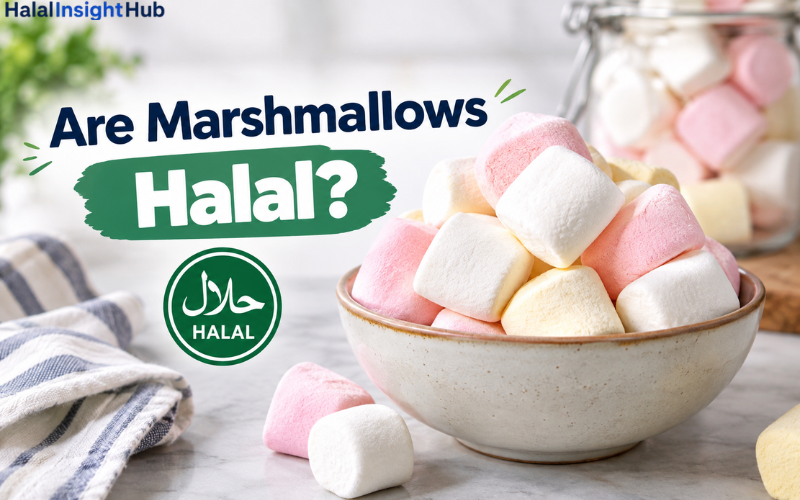
Is marshmallows halal or haram? Yes, Marshmallows can be halal, but not all marshmallows are halal. The main ingredient Muslims need to check is gelatin, which is commonly used to give marshmallows their soft and chewy texture. If the gelatin comes from pork, the marshmallows are not halal. If it comes from halal-certified beef or another permissible source, the marshmallows can be halal.
Because manufacturers use different ingredients and production methods, Muslims should always check the ingredient label and look for reliable halal certification before buying marshmallows.
Quick Answer
Yes, marshmallows can be halal — but it depends mainly on the source of the gelatin.
Many traditional marshmallows contain gelatin derived from pork, which makes them unsuitable for Muslims. However, halal-certified marshmallows made with halal beef gelatin, fish gelatin, or plant-based alternatives can be permissible.
The easiest way to determine whether marshmallows are halal is to:
- Check the ingredient list for gelatin.
- Find out where the gelatin comes from.
- Look for a trusted halal certification.
- Avoid products containing pork-derived ingredients.
- Contact the manufacturer if the gelatin source is unclear.
So, don’t assume every marshmallow is haram or every marshmallow is halal. The ingredients and certification matter.
Marshmallow Halal Status at a Glance
| Question | Answer |
| Are marshmallows halal? | Sometimes |
| Are marshmallows made with gelatin? | Many are |
| Is pork gelatin halal? | No |
| Is halal-certified beef gelatin halal? | Yes |
| Are vegan marshmallows halal? | Often, but ingredients should still be checked |
| Is halal certification useful? | Yes, especially for processed products |
What Are Marshmallows Made Of?
Marshmallows are soft, sweet confectionery products traditionally made with a combination of sugar, water, and gelatin. They may also contain corn syrup, starch, flavorings, and other ingredients depending on the brand.
The ingredient that creates the biggest concern for Muslim consumers is gelatin.
Gelatin is a protein obtained by processing collagen from animal tissues. It can be made from different animal sources, including:
- Pork
- Beef
- Fish
This means the word “gelatin” on a package does not automatically tell you whether the product is halal.
The source of that gelatin must be considered.
Related Posts: Is Wine Vinegar Halal or Haram for Muslims?
Why Does Gelatin Matter for Halal Marshmallows?
Gelatin is important because its Islamic status depends on its source and how it was produced.
If marshmallows contain pork-derived gelatin, Muslims should avoid them. Pork and its derivatives are prohibited in Islamic dietary law.
On the other hand, gelatin derived from a halal animal and produced according to applicable halal requirements may be permissible.
This is why simply seeing “gelatin” in an ingredient list can leave the halal status uncertain.
For Muslims, the safest approach is to check whether the manufacturer identifies the gelatin source or whether the product carries recognized halal certification.
Are Marshmallows Made With Pork Gelatin?
Some marshmallows are made using pork-derived gelatin.
Pork gelatin is widely used in food manufacturing because it provides the texture and elasticity manufacturers want. However, its presence makes the product unsuitable for Muslims.
This is why Muslims should not judge a marshmallow simply by its appearance or brand name.
Two marshmallow products can look almost identical while having completely different halal statuses because they use different sources of gelatin.
Are Beef Gelatin Marshmallows Halal?
Beef gelatin marshmallows can be halal, but the fact that gelatin comes from beef does not automatically guarantee that it is halal.
The source animal and production process both matter.
If the beef comes from an animal that is permissible to eat and the relevant halal slaughter and processing requirements have been met, the gelatin may be halal.
This is why halal-certified beef gelatin is generally a much clearer choice for Muslim consumers than products that simply say “beef gelatin.”
Are Vegan Marshmallows Halal?
Vegan marshmallows can be a good option for Muslims because they are made without animal-derived gelatin.
Instead of gelatin, manufacturers may use plant-based ingredients or other alternatives to create the desired texture.
However, “vegan” and “halal” do not mean exactly the same thing.
A vegan product does not contain animal-derived ingredients, but it can still contain other ingredients that a Muslim consumer may want to verify.
For example, certain flavorings, additives, or processing aids may require further investigation.
Therefore, vegan marshmallows are often a promising option, but checking the ingredient list and halal certification remains a good practice.
Are Marshmallows Halal Without Gelatin?
Marshmallows that contain no gelatin can be halal, provided that their other ingredients are halal.
Some manufacturers use alternatives such as plant-based gelling agents instead of animal-derived gelatin.
However, consumers should still check the complete ingredient list because the absence of gelatin does not automatically make every ingredient halal.
Common Ingredients in Marshmallows
| Ingredient | Halal Consideration |
| Sugar | Generally halal |
| Corn syrup | Generally halal |
| Gelatin | Depends on source |
| Beef gelatin | Halal if properly sourced/certified |
| Pork gelatin | Not halal |
| Fish gelatin | Generally permissible if properly sourced |
| Plant-based gelatin alternatives | Usually halal, but check other ingredients |
| Natural/artificial flavors | Source may need verification |
How Can You Tell If Marshmallows Are Halal?
Determining whether marshmallows are halal does not have to be difficult.
Start by checking the packaging.
1. Look at the Ingredient List
Search for the word gelatin.
If gelatin is listed without identifying its source, you may need additional information from the manufacturer.
2. Look for Halal Certification
A recognized halal certification symbol can make the process much easier.
Halal certification indicates that the product has been reviewed according to the standards of the relevant certifying organization.
3. Check for Pork Ingredients
Avoid marshmallows containing ingredients such as pork gelatin or other clearly pork-derived ingredients.
4. Contact the Manufacturer
If the packaging does not provide enough information, contact the manufacturer and ask specifically about the source of the gelatin.
This is more reliable than guessing based on the product’s appearance or country of origin.
Halal vs. Haram Marshmallows
| Type of Marshmallow | Halal Status | Reason |
| Marshmallow with pork gelatin | ❌ Not halal | Contains pork-derived gelatin |
| Marshmallow with halal-certified beef gelatin | ✅ Halal | Uses permissible certified gelatin |
| Marshmallow with fish gelatin | ✅ Generally halal | Fish is generally permissible |
| Vegan marshmallow | ✅ Often halal | No animal gelatin, but other ingredients should be checked |
| Marshmallow with unknown gelatin source | ⚠️ Uncertain | Source has not been confirmed |
| Halal-certified marshmallow | ✅ Halal | Certified according to the certifier’s standards |
Are Marshmallows Halal in the USA?
The halal status of marshmallows in the United States depends on the brand and product.
American supermarkets sell marshmallows made with different types of gelatin. Some products use pork gelatin, while others use beef gelatin or plant-based alternatives.
Muslim consumers should therefore avoid assuming that all marshmallows sold in the USA have the same halal status.
Look for a halal certification symbol or verify the gelatin source with the manufacturer.
Are Marshmallows Halal in the UK?
The same principle applies in the United Kingdom.
Some marshmallow products may contain pork gelatin, while others may use beef gelatin or alternative ingredients.
Muslim shoppers should check the package carefully and look for recognized halal certification when available.
Country of manufacture alone does not determine whether a marshmallow is halal.
Are Marshmallows Halal in Canada?
Marshmallows in Canada can be halal or non-halal depending on their ingredients and certification.
Products imported from different countries may use different gelatin sources, so reading the package is particularly important.
If you are purchasing marshmallows from a halal grocery store, you may have more options, but checking the certification is still recommended.
Can Muslims Eat Marshmallows?
Yes, Muslims can eat marshmallows when the ingredients meet halal requirements.
The key issue is not the marshmallow itself but the ingredients used to make it.
A Muslim consumer should pay particular attention to gelatin because it is one of the most important ingredients affecting the halal status of traditional marshmallows.
If the marshmallow contains halal-certified gelatin or an appropriate plant-based alternative and no other questionable ingredients, it can generally be eaten.
Are Marshmallow Fluff and Marshmallow Cream Halal?
Marshmallow fluff and marshmallow cream should also be checked carefully.
Some products may use gelatin, while others may use different ingredients to achieve their texture.
Do not assume that a product is halal simply because it is called marshmallow cream or marshmallow fluff.
Check:
- Gelatin source
- Flavorings
- Emulsifiers
- Other animal-derived ingredients
- Halal certification
What About Marshmallows in Hot Chocolate?
Adding marshmallows to hot chocolate does not change their halal status.
If the marshmallows contain pork gelatin, adding them to halal hot chocolate does not make them permissible.
If the marshmallows are halal-certified or made with halal ingredients, they can generally be added to hot chocolate.
The same principle applies to marshmallows used in desserts, cereal, cookies, s’mores, and other foods.
Are Marshmallow S’mores Halal?
S’mores can be halal, but every component should be checked.
A traditional s’more usually contains:
- Marshmallows
- Chocolate
- Graham crackers
The marshmallow may contain pork gelatin, while some chocolate or crackers may contain other ingredients that require verification.
For halal s’mores, use halal-certified marshmallows and check the ingredients of the chocolate and crackers as well.
What Should Muslims Look for on a Marshmallow Label?
| Label Information | What It Means |
| “Halal Certified” | Strong indication that the product has been certified |
| “Beef Gelatin” | Check whether the beef gelatin is halal-certified |
| “Pork Gelatin” | Not suitable for Muslims |
| “Fish Gelatin” | Generally permissible, subject to sourcing |
| “Gelatin” only | Source is unclear; further verification is recommended |
| “Vegan” | No animal gelatin, but check all other ingredients |
Are All Marshmallows Haram?
No. It would be incorrect to say that all marshmallows are haram.
The halal status depends on the ingredients.
Traditional marshmallows can contain pork gelatin, which is a concern for Muslims. But halal-certified marshmallows and some gelatin-free or vegan alternatives are available.
Therefore, Muslims do not need to avoid marshmallows altogether. They simply need to choose products whose ingredients and production meet halal requirements.
“I hope you learned a lot from this article. Check out more articles like this.”
- Is Pepperoni Halal or Haram for Muslims?
- Is Wine Vinegar Halal or Haram for Muslims?
- Is Crab Halal or Haram for Muslims?
- Is Tyson Chicken Halal or Haram for Muslims?
- Is Swedish Fish Halal or Haram for Muslims?
FAQs
Are marshmallows halal?
Some marshmallows are halal, while others are not. The main factor is the source of gelatin and whether the other ingredients are halal.
Is gelatin in marshmallows halal?
It depends on where the gelatin comes from. Pork-derived gelatin is not halal, while properly sourced halal beef or fish gelatin can be permissible.
Are marshmallows made with pork?
Some marshmallows are made with pork-derived gelatin, but not all. Always check the ingredient list and certification.
Are vegan marshmallows halal?
Vegan marshmallows are often suitable for Muslims because they do not contain animal gelatin. However, other ingredients should still be checked.
Can Muslims eat marshmallows?
Yes, Muslims can eat marshmallows when the product is made with halal ingredients and does not contain prohibited substances.
Are beef gelatin marshmallows halal?
They can be halal if the beef gelatin comes from a permissible source and meets halal requirements. Halal certification provides greater confidence.
Are marshmallows halal in Islam?
There is no single ruling for every marshmallow product. The ruling depends on its ingredients, especially the source of gelatin.
How do I know if marshmallows are halal?
Check the ingredient list, identify the source of gelatin, look for halal certification, and contact the manufacturer if the information is unclear.
Related Posts: Is Pepperoni Halal or Haram for Muslims?
Conclusion
Marshmallows are not automatically halal or haram. Their halal status mainly depends on the ingredients used to make them, particularly gelatin.
Marshmallows made with pork-derived gelatin are not suitable for Muslims, while products made with halal-certified beef gelatin, permissible fish gelatin, or suitable plant-based alternatives can be halal.
The safest approach is to check the ingredient label and look for reliable halal certification. If the product simply lists “gelatin” without identifying its source, contacting the manufacturer can help remove uncertainty.
So, if you are wondering “Are marshmallows halal?”, the answer is: some are halal, some are not, and you need to check the ingredients and certification before eating them.

Pingback: Is Squid Halal or Haram for Muslims? -
Pingback: Is Catfish Halal or Haram for Muslims? -