
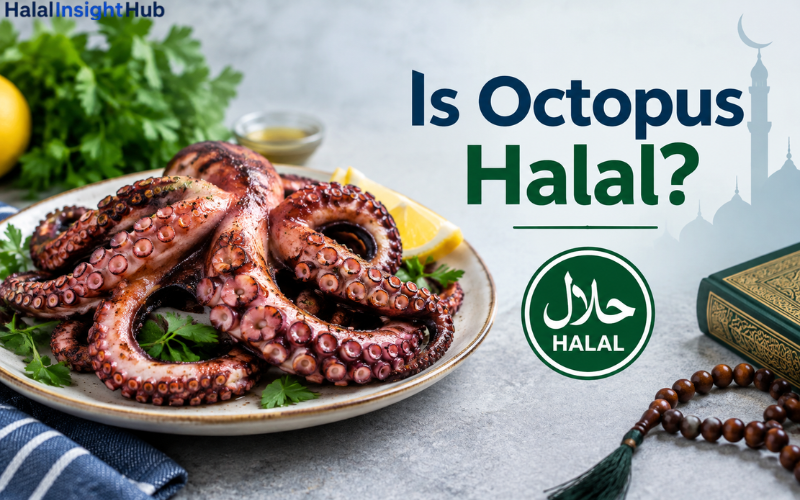
Is octopus halal or haram? Yes, octopus is considered halal by the majority of Islamic scholars. Since octopus is a sea creature, most scholars include it under the general permission for seafood found in the Quran and Sunnah.
However, there is a difference of opinion among Islamic schools. The Shafi’i, Maliki, and Hanbali schools generally permit sea animals, including octopus. The Hanafi school takes a more restrictive approach to seafood, and its traditional position generally limits permissible aquatic animals to fish.
Therefore, Muslims who follow the Hanafi school should consider the guidance of a qualified scholar they trust before eating octopus.
Quick Answer
Yes, octopus is halal according to the majority of Islamic scholars.
The Shafi’i, Maliki, and Hanbali schools generally consider octopus permissible because it lives in the sea. The Hanafi school has a stricter approach to seafood and generally considers only fish from aquatic animals permissible.
So, if you follow the majority view, you can eat octopus. If you follow the Hanafi madhhab, it is better to follow the ruling of a knowledgeable Hanafi scholar.
The octopus itself is not automatically haram simply because it looks unusual or differs from fish.
Octopus Halal Status at a Glance
| Question | Answer |
| Is octopus halal? | ✅ Yes, according to the majority |
| Is octopus mentioned by name in the Quran? | ❌ No |
| Do Shafi’i scholars allow octopus? | ✅ Yes |
| Do Maliki scholars allow octopus? | ✅ Yes |
| Do Hanbali scholars allow octopus? | ✅ Yes |
| What about the Hanafi school? | ⚠️ More restrictive view on seafood |
| Is fried octopus halal? | ✅ If halal ingredients and preparation are used |
What Is an Octopus?
An octopus is a marine animal that belongs to the mollusk family. It lives in oceans around the world and is known for having eight arms, a soft body, and a highly developed nervous system.
Octopus is eaten in many parts of the world, particularly in Mediterranean, East Asian, and coastal cuisines. It can be grilled, boiled, fried, steamed, or included in soups and seafood dishes.
Because octopus does not look like conventional fish, Muslims sometimes wonder whether it qualifies as halal seafood.
The answer depends on the Islamic school of thought being followed.
Related Posts: Is Squid Halal or Haram for Muslims?
What Does the Quran Say About Seafood?
The Quran provides a broad principle regarding food obtained from the sea.
Allah says:
“Lawful to you is game from the sea and its food as provision for you and the travelers.”
(Surah Al-Ma’idah 5:96)
This verse is one of the primary pieces of evidence used by scholars when discussing the permissibility of seafood.
The verse does not specifically mention octopus. Instead, it establishes a general ruling concerning sea food. The majority of scholars therefore understand it as covering various types of marine animals.
This is why octopus is generally considered halal by the majority of Islamic jurists.
What Does the Hadith Say About Sea Animals?
There is also an important hadith concerning seafood.
The Prophet Muhammad ﷺ was asked about performing ablution with seawater. He said:
“Its water is pure and its dead are lawful.”
This hadith is reported in Abu Dawud, al-Tirmidhi, al-Nasa’i, and Ibn Majah.
Scholars use this hadith as evidence that animals from the sea have a special ruling compared with land animals. Unlike land animals, seafood does not generally require the same form of ritual slaughter.
This principle supports the majority position that marine animals such as octopus are permissible.
Is Octopus Halal According to the Four Madhhabs?
The four major Sunni schools do not all approach seafood in exactly the same way.
The main difference is between the majority position and the more restrictive Hanafi approach.
| Islamic School | Ruling on Octopus | General Reason |
| Hanafi | ⚠️ Generally not considered permissible | Traditionally limits permissible seafood mainly to fish |
| Shafi’i | ✅ Halal | Sea animals are generally permissible |
| Maliki | ✅ Halal | Broad permissibility of sea animals |
| Hanbali | ✅ Halal | Sea animals are generally permissible |
Let’s look at each school in more detail.
Is Octopus Halal According to the Hanafi School?
The Hanafi school has a more restrictive position concerning seafood than the other three major Sunni schools.
According to the traditional Hanafi approach, the seafood that is clearly permissible is fish. Animals that are not considered fish are generally not treated in the same way.
Since octopus is a mollusk rather than a fish, the traditional Hanafi position generally does not consider it permissible to eat.
This is an important distinction for Muslims who follow the Hanafi madhhab.
However, Islamic jurisprudence contains detailed discussions about aquatic animals, and individual scholars may explain the issue differently depending on their interpretation and the circumstances.
If you follow the Hanafi school, it is best to ask a qualified Hanafi scholar rather than relying solely on a general internet answer.
Is Octopus Halal According to the Shafi’i School?
Yes, octopus is generally considered halal according to the Shafi’i school.
The Shafi’i madhhab takes a broad approach to animals that live in the sea. Since octopus is a marine animal, it falls within the category of permissible seafood.
Therefore, Muslims following the Shafi’i school can generally eat octopus without concern about the animal itself.
The preparation still needs to be considered, however. A halal seafood ingredient could become questionable if it is cooked with prohibited ingredients.
Is Octopus Halal According to the Maliki School?
Yes.
The Maliki school generally has a broad ruling regarding sea animals. Marine creatures are generally considered permissible unless there is specific evidence establishing prohibition.
Because octopus is a sea creature, it is therefore considered halal according to the Maliki approach.
This means Muslims following the Maliki madhhab can generally eat octopus.
Is Octopus Halal According to the Hanbali School?
Yes, octopus is generally considered halal according to the Hanbali school.
The Hanbali approach permits sea animals based on the Quranic and Prophetic evidence concerning seafood.
Since octopus lives in the sea, it falls within the category of marine animals that are generally permissible.
Why Do Scholars Differ About Octopus?
The difference is mainly related to how Islamic scholars classify sea animals.
The majority of schools understand the Quranic permission concerning seafood broadly. Under this interpretation, various marine creatures are permissible unless there is clear evidence prohibiting them.
The Hanafi school, however, uses a narrower classification. Its traditional position gives special importance to whether an aquatic creature qualifies as a fish.
Because an octopus is biologically a mollusk rather than a fish, it does not fall within the same category under the traditional Hanafi approach.
Therefore, the disagreement is not because octopus is specifically declared haram in the Quran. Rather, it comes from different methods of interpreting and applying Islamic dietary principles.
Can Muslims Eat Octopus?
For Muslims following the majority scholarly view, yes, octopus can be eaten.
However, the preparation should also meet halal requirements.
For example, octopus could become problematic if it is:
- Cooked with alcohol
- Prepared with pork ingredients
- Mixed with non-halal meat
- Covered in a sauce containing prohibited ingredients
- Cooked using equipment contaminated with haram substances
The ruling of the octopus itself and the ruling of the complete dish should therefore be considered separately.
Is Fried Octopus Halal?
Yes, fried octopus can be halal according to the majority view.
The cooking method itself does not make octopus haram. What matters is what ingredients and cooking equipment are used.
For example, fried octopus should be checked for:
- The frying oil
- Batter ingredients
- Seasonings
- Sauces
- Shared fryers
If the ingredients are halal and there is no problematic contamination, fried octopus remains permissible according to the majority opinion.
Is Grilled Octopus Halal?
Yes, grilled octopus is generally halal according to the majority of scholars.
Grilling is simply a method of preparation and does not change the basic ruling of the seafood.
However, restaurants sometimes use marinades, sauces, or seasonings that may contain alcohol or other questionable ingredients.
If you are eating grilled octopus at a restaurant, checking the ingredients is a good practice.
Is Octopus Sushi Halal?
Octopus sushi can be halal, but Muslims should examine the entire dish rather than just the seafood.
The octopus itself is considered halal according to the majority opinion. However, sushi may contain other ingredients that require checking.
Pay attention to:
- Mirin
- Sake
- Alcohol-based sauces
- Non-halal mayonnaise
- Non-halal meat
- Cross-contamination
Plain octopus with rice and permissible ingredients is generally not problematic according to the majority view.
Is Octopus Halal in Restaurants?
If you follow the majority scholarly opinion, you can generally order octopus at a restaurant, but you should still check how it is prepared.
This becomes particularly important at restaurants serving both seafood and non-halal meat.
Before ordering, you can ask:
- Does the dish contain alcohol?
- Is the sauce made with wine or sake?
- Is the octopus cooked with pork?
- Is the same grill or fryer used for non-halal foods?
- Are there any questionable ingredients in the marinade?
These questions can help you avoid hidden ingredients.
Octopus Compared With Other Seafood
| Seafood | Majority View | Hanafi Consideration |
| Fish | Halal | Halal |
| Shrimp | Halal | Many scholars permit it |
| Octopus | Halal | Generally not permissible traditionally |
| Crab | Halal | Generally not permissible traditionally |
| Lobster | Halal | Generally not permissible traditionally |
| Squid | Halal | Generally not permissible traditionally |
| Oysters | Halal | Generally not permissible traditionally |
This comparison highlights the major difference between the majority schools and the traditional Hanafi approach to seafood.
Is Octopus Healthy to Eat?
From a nutritional perspective, octopus can be a nutritious seafood option.
It provides protein and several important nutrients, including vitamin B12, selenium, iron, and other minerals.
However, the nutritional value can change significantly depending on how it is prepared.
For example, grilled or boiled octopus may have a very different nutritional profile from heavily battered and deep-fried octopus.
| Nutrient | Potential Benefit |
| Protein | Supports muscle maintenance and repair |
| Vitamin B12 | Supports normal nerve and blood-cell function |
| Selenium | Helps support antioxidant defenses |
| Iron | Important for oxygen transport |
| Minerals | Support various body functions |
As with any food, moderation and a balanced diet are important.
How to Make Sure Octopus Is Halal
If you follow the majority opinion and want to eat octopus while maintaining halal dietary practices, consider these simple steps:
Check the Ingredients
Look at sauces, marinades, seasonings, and other ingredients added to the octopus.
Avoid Alcohol-Based Sauces
Some seafood dishes use wine, sake, or other alcoholic ingredients.
Ask About Shared Equipment
Restaurants may use the same grills, fryers, or cooking surfaces for different foods.
Look for Halal Certification
When buying processed octopus products or eating at a restaurant, recognized halal certification can provide additional reassurance.
Follow Your Madhhab
If you follow the Hanafi school, consult a trusted Hanafi scholar regarding the ruling you should follow.
“I hope you learned a lot from this article. Check out more articles like this.”
- Is Catfish Halal or Haram for Muslims?
- Is Squid Halal or Haram for Muslims?
- Is Crab Halal or Haram for Muslims?
- Is Tyson Chicken Halal or Haram for Muslims?
- Is Swedish Fish Halal or Haram for Muslims?
FAQs
Is octopus halal in Islam?
Yes, octopus is considered halal by the majority of Islamic scholars. The Shafi’i, Maliki, and Hanbali schools generally permit it as a sea animal.
Is octopus halal according to Hanafi scholars?
The traditional Hanafi position generally does not permit octopus because it is not classified as a fish. Muslims following the Hanafi madhhab should follow the guidance of a qualified Hanafi scholar.
Is octopus mentioned in the Quran?
No, the Quran does not specifically mention octopus by name. The majority ruling is based on the general Quranic permission concerning food from the sea.
Is grilled octopus halal?
Yes, grilled octopus is generally halal according to the majority view, provided it is prepared with halal ingredients and without prohibited sauces or contamination.
Is fried octopus halal?
Yes, fried octopus is halal according to the majority opinion if the batter, oil, seasonings, and other ingredients are halal.
Is octopus sushi halal?
Octopus itself is generally halal according to the majority of scholars. However, sushi ingredients such as sake, mirin, or certain sauces should be checked.
Can Muslims eat octopus?
Yes, Muslims following the majority scholarly view can eat octopus. Those following the traditional Hanafi position should avoid it unless following a scholarly opinion that permits it.
Is octopus seafood?
Yes. Octopus is a marine mollusk and is commonly classified as seafood. Its classification as a non-fish sea animal is one reason the Hanafi ruling differs from the majority view.
Related Posts: Is Catfish Halal or Haram for Muslims?
Conclusion
So, is octopus halal? According to the majority of Islamic scholars, yes, octopus is halal. The Shafi’i, Maliki, and Hanbali schools generally permit octopus because it is a sea creature covered by the broad permissibility of seafood.
The main difference comes from the Hanafi school, which traditionally takes a more restrictive approach and generally limits permissible aquatic animals to fish. Since octopus is not a fish, the traditional Hanafi position does not generally permit eating it.
For Muslims who follow the majority opinion, octopus can be enjoyed as long as the ingredients and preparation are halal. When eating octopus at restaurants, it is still important to check sauces, marinades, alcohol-based ingredients, and possible cross-contamination.
If you follow the Hanafi madhhab, consult a trusted qualified scholar for guidance according to the position you follow.
Overall, octopus is halal according to the majority view, but there is a recognized difference of opinion that Muslims should be aware of.


Pingback: Is Oysters Halal or Haram for Muslims? -