
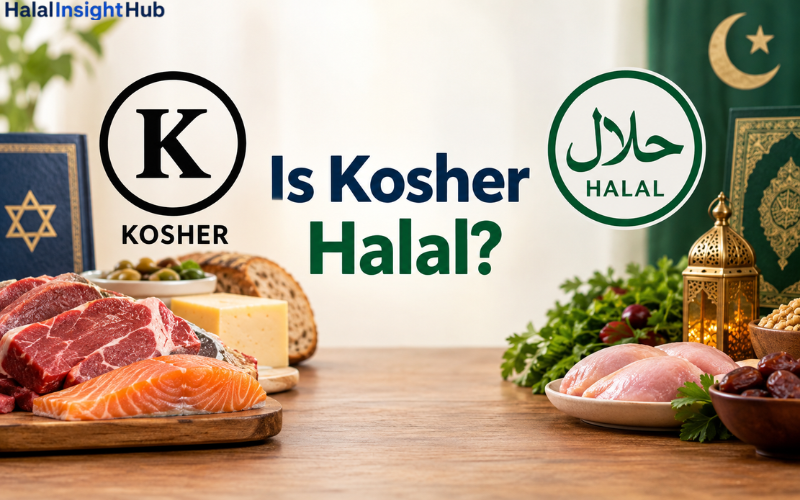
Is Kosher Halal or Haram? No, Kosher food is not automatically halal, but some kosher foods may be permissible for Muslims. Both kosher and halal dietary laws prohibit pork and blood and establish rules for meat and food preparation. However, they differ in certain requirements, including slaughter practices, alcohol, and some animal-derived ingredients.
Whether Muslims can eat kosher meat is also a matter of scholarly interpretation. Some Islamic scholars permit it under the rules concerning the food of the People of the Book, while others require additional conditions to be met. Muslims should therefore check ingredients, understand the certification, and follow a trusted scholar’s guidance.
Quick Answer
Is kosher halal? Not always. Kosher certification means that a product meets Jewish dietary requirements, not necessarily Islamic halal standards. Many kosher products made from plant-based ingredients may be suitable for Muslims, provided they contain no prohibited ingredients or processing aids. However, kosher meat, gelatin, wine, and certain food additives require additional attention.
Before eating a kosher product, check its ingredients and look for reliable halal certification when available. If you are unsure about kosher meat or an animal-derived ingredient, consult a qualified Islamic scholar.
What Does Kosher Mean?
Kosher refers to food that complies with Jewish dietary laws, which are known as kashrut. These rules determine which foods Jewish people may eat and how certain foods must be prepared, processed, and handled.
Kosher dietary requirements come from Jewish religious teachings and traditions. They cover permitted animals, slaughter practices, blood removal, food preparation, and the separation of meat and dairy.
For example, kosher laws prohibit pork and require meat to undergo specific slaughter and blood-removal procedures. They also prohibit combining meat and dairy in ways that violate Jewish dietary rules.
Kosher certification is generally provided by a recognized Jewish organization that supervises or verifies compliance with these requirements.
However, Muslims should understand one important point: kosher and halal are two different religious food standards. A product may satisfy Jewish dietary requirements without meeting every Islamic dietary requirement.
Related Posts: Is Turkey Bacon Halal or Haram for Muslims?
What Does Halal Mean in Islam?
Halal is an Arabic word meaning permissible or lawful. In Islam, halal food refers to food that Muslims are permitted to consume under Islamic teachings.
Islamic dietary rules identify prohibited foods and establish conditions for slaughtering permissible land animals. They also prohibit intoxicants and require Muslims to avoid food contaminated with prohibited substances.
Examples of prohibited foods and substances include:
- Pork and pork-derived ingredients.
- Blood intended for consumption.
- Meat from animals that were not slaughtered according to the applicable Islamic requirements.
- Intoxicating alcoholic beverages.
- Food containing prohibited ingredients or contaminated through contact with them.
Halal certification helps consumers identify products that have been assessed against the requirements of a particular halal certification authority.
The Islamic Food and Nutrition Council of America (IFANCA) explains that animal-derived ingredients such as gelatin need to be checked for their source and, where applicable, the animal’s slaughter status.
Kosher vs. Halal: What Is the Difference?
Kosher and halal share several dietary principles, but they are not identical. The most important differences concern slaughter requirements, alcohol, certain ingredients, and food preparation.
| Feature | Kosher Food | Halal Food |
| Religious basis | Jewish dietary law | Islamic dietary law |
| Pork | Prohibited | Prohibited |
| Blood | Consumption prohibited | Consumption prohibited |
| Meat slaughter | Must follow Jewish slaughter requirements | Must meet applicable Islamic slaughter requirements |
| Alcohol | Certain alcoholic products may be kosher | Intoxicating alcoholic beverages are prohibited |
| Meat and dairy | Subject to separation rules | No equivalent general prohibition on combining halal meat and dairy |
| Certification | Issued by a kosher certifying organization | Issued by a halal certifying organization |
These differences are important because a kosher symbol does not establish that every ingredient and production method complies with Islamic dietary rules. Research comparing the two systems also identifies differences in slaughter, alcohol, and food processing.
Can Muslims Eat Kosher Food?
Muslims may be able to eat many kosher foods, but the answer depends on the ingredients, processing methods, and type of product.
For example, plain fruits, vegetables, rice, and other naturally permissible foods are generally halal when they have not been contaminated with prohibited substances. A kosher label can provide useful information, but it is not a substitute for checking the product itself.
Packaged foods require more attention because they may contain flavorings, enzymes, gelatin, emulsifiers, or alcohol-based ingredients.
Some scholars permit kosher food and meat under the Islamic rules concerning the food of the People of the Book. Other scholars impose stricter conditions, particularly regarding slaughter and the source of animal-derived ingredients.
For this reason, it is misleading to say that all kosher food is halal or that all kosher food is haram. Each product should be assessed according to its ingredients and relevant Islamic requirements.
Is Kosher Meat Halal?
Kosher meat is one of the most debated aspects of the kosher-versus-halal question.
Jewish dietary law requires a specific method of slaughter known as shechita. Islamic slaughter, commonly called dhabiha or zabiha, has its own religious requirements.
The Quran addresses the food of the People of the Book in Surah Al-Ma’idah 5:5. Scholars differ in how they apply this permission to commercially available kosher meat and whether the particular slaughter practices satisfy Islamic requirements.
Some scholars consider genuinely kosher meat permissible under specified conditions. Others require confirmation that the slaughter meets the conditions they consider necessary under Islamic law, including requirements concerning the invocation of Allah’s name.
Therefore, a kosher certificate alone does not settle the question for every Muslim.
If you follow a particular school of Islamic jurisprudence or a trusted scholar, ask for guidance that takes your circumstances and the actual slaughter process into account. If you want to avoid this uncertainty, choose meat carrying reliable halal certification.
Is Kosher Chicken Halal?
Kosher chicken is not automatically halal simply because it has been certified kosher.
Chicken is a permissible type of animal in Islam, but the slaughter and handling of the meat also matter. Kosher chicken is processed according to Jewish religious requirements, which differ from Islamic requirements in certain respects.
Some scholars permit kosher chicken under their interpretation of the rules concerning the food of the People of the Book. Others do not accept it without confirmation that the relevant Islamic slaughter requirements have been met.
Muslims who require independently verified halal slaughter should choose chicken with reliable halal certification.
Before buying kosher chicken, consider these questions:
- Is the product certified only as kosher, or does it also have halal certification?
- Can the supplier provide information about the slaughter process?
- Does the scholar whose guidance you follow permit this type of meat?
- Has the chicken been processed or stored in a way that introduces prohibited ingredients?
These checks help you make an informed decision rather than relying on the kosher label alone.
Is Kosher Gelatin Halal?
Kosher gelatin is not automatically halal. Its permissibility depends on its source, processing, and the Islamic ruling followed.
Gelatin is commonly used in gummy candies, marshmallows, desserts, yogurt, and capsules. It can be derived from animal tissues, including cattle, pigs, and fish.
A kosher symbol does not necessarily tell Muslim consumers whether the gelatin meets their halal requirements. Some kosher authorities accept ingredients under Jewish dietary rules that certain halal certifiers or scholars would not accept.
| Gelatin Source | Halal Consideration |
| Pork-derived gelatin | Haram |
| Fish gelatin | Generally halal if the source and processing are acceptable |
| Beef gelatin from halal-slaughtered cattle | Generally halal if processing and other ingredients comply |
| Beef gelatin from kosher-slaughtered cattle | Scholarly views differ; verify before consuming |
| Gelatin with an unknown source | Requires further investigation |
For packaged sweets and desserts, look for the gelatin source on the label or contact the manufacturer. A recognized halal certification can provide additional assurance.
Is Kosher Alcohol Halal?
No. A kosher certification does not make an intoxicating alcoholic beverage halal.
Jewish dietary law permits certain alcoholic beverages, including wine, when they meet the relevant kosher requirements. Islamic dietary rules prohibit intoxicating alcoholic beverages.
This difference matters when checking wine, liqueurs, cooking wines, and certain flavoring ingredients. A product may be kosher-certified while still containing an ingredient that Muslims avoid.
For example, kosher wine is not automatically halal wine. Similarly, a kosher product containing wine or a prohibited alcoholic ingredient cannot be assumed permissible simply because it carries a kosher symbol.
Read the ingredient list carefully. If an ingredient’s identity, source, or use is unclear, contact the manufacturer or consult a qualified scholar.
Are Kosher Snacks and Candy Halal?
Some kosher snacks and candies may be suitable for Muslims, but kosher certification does not guarantee that every product is halal.
Plain potato chips made with permissible ingredients, for example, may be halal if their flavorings and manufacturing process meet Islamic requirements. However, flavored snacks can contain animal-derived additives, questionable enzymes, or ingredients that require further verification.
Gummy candies and marshmallows deserve particular attention because they may contain gelatin. Chocolate, baked goods, and desserts may also contain alcohol-based flavorings or other ingredients that need checking.
Use the following guide when shopping:
| Product Type | What Muslims Should Check |
| Plain chips | Oils, seasonings, and flavoring ingredients |
| Gummy candies | Gelatin source and other additives |
| Marshmallows | Gelatin source and manufacturing ingredients |
| Chocolate | Flavorings, emulsifiers, and any alcohol-containing ingredients |
| Bread and baked goods | Enzymes, shortening, flavorings, and processing aids |
| Cheese | Enzymes and the source of rennet |
The key is to evaluate the actual ingredients rather than assuming that a kosher label automatically confirms halal status.
How to Check Whether a Kosher Product Is Halal
If you find a kosher product at a supermarket and cannot find a halal alternative, use these steps to make a more informed decision.
1. Read the Ingredient List
Look for pork-derived ingredients, gelatin, animal enzymes, alcohol, and other substances that may require verification. Remember that ingredient names do not always reveal their source.
2. Identify Animal-Derived Ingredients
Ingredients such as gelatin, rennet, and certain enzymes may come from different sources. Ask the manufacturer whether they are plant-based, fish-derived, or obtained from land animals.
3. Look for Halal Certification
If the product carries a halal certification from an organization you trust, this can provide stronger evidence that it meets that organization’s Islamic dietary standards.
4. Contact the Manufacturer
When the label does not provide enough information, ask the manufacturer about the ingredient source, alcohol content, processing aids, and production methods.
5. Follow Trusted Islamic Guidance
If the question concerns kosher meat or a disputed ingredient, consult a qualified Islamic scholar who understands the relevant ingredients and production process.
These steps are especially useful for processed foods, where a product’s full composition may not be obvious from its name or packaging.
“I hope you learned a lot from this article. Check out more articles like this.”
- Is Turkey Bacon Halal or Haram for Muslims?
- Is Chocolate liquor Halal or Haram for Muslims?
- Is Vanilla extract Halal or Haram for Muslims?
- Is Crab Halal or Haram for Muslims?
- Is Swedish Fish Halal or Haram for Muslims?
FAQs
Is kosher halal for Muslims?
Not automatically. Some kosher foods may be halal, but others contain ingredients or use processes that do not meet Islamic dietary requirements. Kosher meat is also subject to differing scholarly opinions.
Can Muslims eat kosher meat?
Some Islamic scholars permit kosher meat under specified conditions, while others require additional confirmation about slaughter requirements. Muslims should follow a trusted scholar’s guidance.
Is kosher chicken halal?
Kosher chicken is not automatically halal. Its permissibility depends on the slaughter requirements and the interpretation followed by the consumer’s Islamic authority.
Is kosher gelatin halal?
Not necessarily. The source of the gelatin matters. Pork-derived gelatin is haram, while fish gelatin is generally halal when other requirements are met. Kosher beef gelatin may require further verification.
Is kosher wine halal?
No. Kosher certification does not make wine permissible under Islamic dietary rules. Muslims should avoid wine and other intoxicating alcoholic beverages.
Are kosher snacks halal?
Some kosher snacks may be halal if all ingredients and processing methods comply with Islamic requirements. Flavored snacks, candies, and marshmallows may need additional ingredient checks.
Does kosher certification mean a product contains no pork?
A valid kosher certification generally excludes pork and pork-derived ingredients under the applicable kosher standards. However, it does not establish that every other ingredient is halal.
Is kosher the same as halal?
No. Both systems share some dietary restrictions, but their religious requirements differ in areas such as slaughter, alcohol, and food preparation.
Related Posts: Is Turkey Bacon Halal or Haram for Muslims?
Conclusion
Kosher food and halal food share important similarities, but they are not interchangeable. Although many kosher products may be suitable for Muslims, kosher certification alone does not guarantee compliance with Islamic dietary requirements.
The main concerns are kosher meat, gelatin, alcohol, and other ingredients whose sources or processing methods may be unclear. Scholarly opinions also differ on whether certain kosher meats are permissible for Muslims, so it is important to follow reliable Islamic guidance.
When shopping, read ingredient labels, investigate animal-derived ingredients, and look for trusted halal certification whenever possible. If you are uncertain about a product, contact the manufacturer or consult a qualified scholar.

Pingback: Is Sugar Alchohol Halal or Haram for Muslims? -