
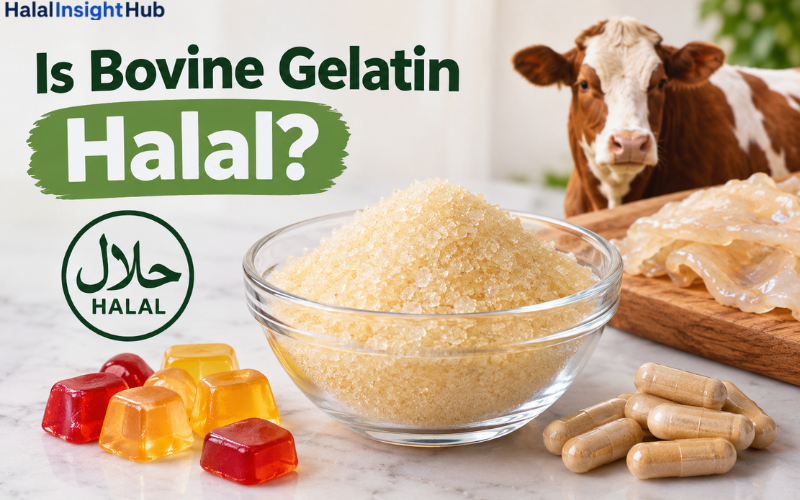
Is Bovine gelatine halal or haram? Yes, Bovine gelatin is halal only when its source and production meet the applicable Islamic requirements, according to many Islamic scholars and halal certification authorities. Although bovine gelatin comes from cattle rather than pigs, that does not automatically make it halal.
Its halal status depends on how the animal was slaughtered, the source of the raw materials, and the standards followed during manufacturing. Some scholars also differ on whether the processing of gelatin can change the Islamic ruling on its original source.
If you are a Muslim checking ingredients in candy, marshmallows, yogurt, desserts, or capsules, understanding these differences can help you make an informed decision.
Quick Answer: Is Bovine Gelatin Halal or Haram?
The verdict: Bovine gelatin is not automatically halal. It is generally considered permissible by many scholars when it comes from cattle slaughtered according to Islamic requirements and is processed in accordance with halal standards.
If the gelatin comes from cattle that were not slaughtered Islamically, many scholars consider it impermissible. Other scholars discuss whether the manufacturing process causes a complete transformation, known as istihalah, that could affect its ruling.
The easiest way to make a confident choice is to look for reliable halal certification that covers the gelatin ingredient and the finished product. If the source is unknown, do not assume that the word “bovine” means halal.
What Is Bovine Gelatin?
Bovine gelatin is a protein-based ingredient obtained by processing collagen from cattle. The raw materials commonly include cowhide, skin, bones, and connective tissues.
Manufacturers process these materials to extract gelatin, which can form a gel, thicken liquids, stabilize mixtures, or improve the texture of food products.
Bovine gelatin is widely used in the food, pharmaceutical, and supplement industries. It can appear in products that do not look like meat, which is why Muslims often check ingredient labels carefully.
Examples of products that may contain bovine gelatin include:
- Gummy candies and jelly sweets
- Marshmallows
- Gelatin desserts and puddings
- Some yogurts and dairy desserts
- Certain vitamin and supplement capsules
- Some pharmaceutical products
Not every product in these categories contains bovine gelatin. Ingredients vary by manufacturer, country, and product formulation.
Related Posts: Is Vanilla extract Halal or Haram for Muslims?
What Does Bovine Mean on an Ingredient Label?
The word “bovine” refers to cattle, including cows and related animals. Therefore, bovine gelatin comes from cattle rather than pigs.
However, the term identifies the animal source, not the animal’s slaughter method or the ingredient’s halal certification.
For example, a product labeled “bovine gelatin” could use gelatin from halal-slaughtered cattle or cattle that were not slaughtered according to Islamic requirements. The ingredient name alone does not tell you which source was used.
This distinction is essential when deciding whether a food product is suitable for Muslims.
Is Bovine Gelatin Halal According to Islam?
Islamic rulings on bovine gelatin generally focus on two important questions: whether the original animal was permissible and slaughtered according to Islamic requirements, and whether the manufacturing process changes the substance sufficiently to affect its ruling.
Many scholars and halal certification bodies accept gelatin made from permissible animals slaughtered according to Islamic requirements. They generally reject gelatin from prohibited sources, including pigs.
Some scholars also consider gelatin from animals that were not slaughtered Islamically impermissible because they do not regard ordinary gelatin processing as a complete transformation of the original material.
Other scholarly discussions address whether a genuine chemical transformation, or istihalah, can change the ruling of an ingredient. The application of this principle to gelatin is disputed.
For this reason, Muslims should not assume that all bovine gelatin is halal simply because it comes from cattle. If you follow a particular school of Islamic jurisprudence or a trusted scholar, consult their guidance on gelatin from uncertain sources.
Bovine Gelatin Halal Status by Source
The following table summarizes the general approach followed by many halal authorities and scholars. Individual rulings may differ, particularly where the source or transformation process is disputed.
| Gelatin Source | General Halal Assessment | What to Check |
| Cattle slaughtered according to Islamic requirements | Generally permissible | Reliable certification and production controls |
| Cattle not slaughtered according to Islamic requirements | Considered impermissible by many scholars | Consult your trusted scholar if considering the transformation argument |
| Cattle of unknown slaughter status | Cannot automatically be considered halal | Source documentation and halal certification |
| Pig-derived gelatin | Prohibited by mainstream halal standards | Avoid products containing it |
| Fish-derived gelatin | Generally permissible when the source and processing are acceptable | Ingredient source and any relevant certification |
| Plant-based gelling agents | Generally suitable for halal diets | Check other ingredients and processing aids |
What Is the Difference Between Bovine Gelatin and Porcine Gelatin?
Bovine gelatin and porcine gelatin are both animal-derived ingredients, but they come from different animals.
Bovine gelatin is made from cattle, while porcine gelatin is made from pigs. This distinction matters because pigs are prohibited as a food source under mainstream Islamic dietary rules.
However, bovine gelatin still requires attention to slaughter requirements and production standards. Its animal source alone does not guarantee that it is halal.
| Feature | Bovine Gelatin | Porcine Gelatin |
| Source | Cattle | Pigs |
| Animal source permissible in principle? | Yes, subject to Islamic requirements | No under mainstream halal standards |
| Can be halal-certified? | Yes, when the applicable requirements are met | Not under mainstream halal certification standards |
| Common uses | Sweets, desserts, capsules | Sweets, desserts, capsules |
| What Muslims should do | Verify source and certification | Avoid products containing it |
A product labeled “beef gelatin” or “bovine gelatin” is not necessarily halal-certified. Likewise, a product’s vegetarian-friendly appearance does not establish that it contains no animal-derived ingredients.
How Is Bovine Gelatin Made?
Understanding the manufacturing process helps explain why gelatin raises questions in Islamic dietary law.
1. Collecting the Raw Materials
Manufacturers obtain collagen-containing materials, such as cattle skin, hides, and bones, from their suppliers. The animal source and its slaughter status are important for halal compliance.
2. Cleaning and Preparing the Materials
The raw materials are cleaned and prepared to remove unwanted substances and make the collagen easier to extract.
3. Extracting the Collagen
The materials undergo processing, which can involve water, heat, and other controlled treatments, to extract gelatin from collagen.
4. Filtering and Purifying
The extracted material is filtered and purified to achieve the required quality, consistency, and safety standards.
5. Drying and Packaging
The gelatin is dried and converted into powder, granules, or other forms for use in food, supplements, and pharmaceuticals.
The fact that gelatin undergoes extensive processing does not automatically settle its halal status. Many scholars who consider the original source decisive do not regard ordinary gelatin manufacturing as sufficient to change the Islamic ruling. Others discuss whether a complete transformation can occur in certain circumstances.
What Is Istihalah, and Why Does It Matter?
Istihalah is an Islamic jurisprudential concept referring to the transformation of a substance into something different in its nature and characteristics.
It is relevant to gelatin because manufacturers transform collagen-containing animal materials into a processed protein ingredient.
Some scholars argue that a sufficiently complete transformation can affect the ruling of the resulting substance. Other scholars maintain that the processing used to manufacture gelatin does not meet the conditions necessary for such a transformation.
Consequently, the fact that a substance has been chemically processed does not, by itself, prove that every scholar will consider it halal.
For practical purposes, Muslims should look for trustworthy halal certification and follow reliable religious guidance rather than relying on a general claim that gelatin has been transformed.
Is Bovine Gelatin Halal in Food Products?
Bovine gelatin may be found in many packaged foods, but its status depends on the source and production process.
Gummies and Jelly Sweets
Gummy candies and jelly sweets often use gelatin to create their chewy texture. If the gelatin is halal-certified, it can be suitable for Muslims, subject to the other ingredients. If its source is unclear, check the manufacturer’s information.
Marshmallows
Some marshmallows contain gelatin to give them a soft, springy texture. Others use alternative ingredients. Check the label to determine whether the product uses halal-certified bovine gelatin or a suitable alternative.
Yogurt and Dairy Desserts
Certain dairy desserts use gelatin as a stabilizer or thickener. Milk does not automatically make a finished product halal-certified, so check the complete ingredient list and certification status.
Cakes and Desserts
Some commercial cakes, mousses, puddings, and other desserts contain gelatin. Recipes vary, and gelatin may not always be clearly identified by its animal source on the front of the package.
Supplements and Capsules
Some vitamin products and supplements use gelatin capsules. Both bovine and porcine gelatin are used in manufacturing, so check the capsule material and the finished product’s certification.
How to Identify Halal Bovine Gelatin
If you want to avoid doubtful ingredients, use the following checks before purchasing a product.
| Check | What It Tells You | Recommended Action |
| Halal logo or certificate | The product has been assessed under a particular halal certification scheme | Verify the certifier and certificate where possible |
| Ingredient list | May identify gelatin or its animal source | Look for bovine, beef, porcine, or fish gelatin |
| Manufacturer information | May explain sourcing and processing | Ask for the source and supporting documentation |
| Product-specific certification | Helps confirm the status of the actual product | Check that the certificate covers the product you are buying |
A halal logo is most useful when it comes from a credible certification body and applies to the specific product. Do not assume that every product made by a certified manufacturer is covered by the same certificate.
In Pakistan, consumers can consult the Pakistan Halal Authority’s published licensed-products list for relevant manufacturers and products. The list includes licensed entries for edible gelatin and bovine-skin gelatin, but the status of the specific product should still be checked.
What Are the Best Halal Alternatives to Bovine Gelatin?
If you cannot confirm the source of gelatin, you may prefer products made with suitable non-animal gelling agents.
Agar-Agar
Agar-agar is derived from seaweed and is commonly used in jellies, puddings, and desserts. It can provide a firm texture, although its behavior differs from gelatin.
Pectin
Pectin is a plant-derived substance commonly used in jams, fruit jellies, and gummy sweets. It is a useful alternative for many recipes.
Carrageenan
Carrageenan is extracted from certain types of seaweed and is used as a thickener or stabilizer in selected dairy and other food products.
Certified Halal Gelatin
You do not necessarily need to avoid all animal-derived gelatin. If a product uses gelatin from an acceptable source and meets the relevant halal requirements, certified gelatin can be a suitable option.
Always check the full ingredient list, because an alternative thickener does not automatically guarantee that every other ingredient in a product is halal.
Can Muslims Eat Products Containing Bovine Gelatin?
Yes, Muslims can generally consume products containing bovine gelatin when the ingredient meets the halal requirements accepted by their trusted religious authority.
The difficulty arises when the animal source or slaughter status is unknown. Some scholars consider such gelatin impermissible if the animal was not slaughtered Islamically, while scholarly discussions about istihalah differ.
If the manufacturer cannot provide reliable information, choose a product with clear halal certification or one made with an acceptable alternative ingredient.
For medicines, supplements, or capsules that are medically necessary, ask a qualified healthcare professional about suitable alternatives and consult a trusted Islamic scholar if the religious ruling is uncertain.
“I hope you learned a lot from this article. Check out more articles like this.”
- Is Chocolate liquor Halal or Haram for Muslims?
- Is Vanilla extract Halal or Haram for Muslims?
- Is Crab Halal or Haram for Muslims?
- Is Tyson Chicken Halal or Haram for Muslims?
- Is Swedish Fish Halal or Haram for Muslims?
FAQs
Is bovine gelatin halal or haram?
Bovine gelatin is generally considered halal when it comes from cattle slaughtered according to Islamic requirements and meets relevant halal production standards. If the source is not halal, many scholars consider it impermissible.
Is bovine gelatin made from cows or pigs?
Bovine gelatin comes from cattle, not pigs. Porcine gelatin is the type derived from pigs. However, bovine gelatin is not automatically halal simply because its source is cattle.
Is beef gelatin the same as bovine gelatin?
In ordinary food labeling, beef gelatin and bovine gelatin generally refer to gelatin derived from cattle. Neither term alone proves that the ingredient is halal-certified.
Is bovine gelatin halal in gummy bears?
It can be halal if the gelatin source and manufacturing process meet the relevant halal requirements. Check the product’s halal certification rather than assuming all gummy bears containing bovine gelatin are permissible.
Is bovine gelatin halal according to the Hanafi school?
Many Hanafi scholars consider gelatin from cattle that were not slaughtered according to Islamic requirements impermissible. They generally do not accept ordinary gelatin processing as sufficient transformation, although discussions about istihalah exist. Follow a qualified scholar’s guidance for your specific situation.
Is halal-certified bovine gelatin permissible?
Generally, yes, when the certification is credible, current, and applicable to the ingredient or finished product. Check the scope of the certification and any other ingredients.
Is bovine gelatin halal in medicine?
It depends on the gelatin’s source, the applicable religious ruling, and the product’s circumstances. If an alternative is available, ask your healthcare professional about it. Do not stop prescribed medication without medical advice.
Is plant-based gelatin halal?
A plant-based gelling agent such as agar-agar or pectin is generally suitable for halal diets, provided the other ingredients and processing aids are also acceptable.
Related Posts: Is Chocolate liquor Halal or Haram for Muslims?
Conclusion
Bovine gelatin is not automatically halal just because it comes from cattle rather than pigs. Its status depends on the animal’s source, slaughter requirements, manufacturing process, and the Islamic standards applied to the ingredient.
Many scholars consider bovine gelatin permissible when it comes from cattle slaughtered according to Islamic requirements and is produced under appropriate halal controls. However, gelatin from animals not slaughtered Islamically is considered impermissible by many scholars, and they differ on whether the manufacturing process can change that ruling through istihalah.
For Muslims who want to make informed food choices, the most practical approach is to check the ingredient label, look for reliable halal certification, and contact the manufacturer when the source is unclear. Suitable alternatives such as agar-agar and pectin can also help when halal status cannot be verified.

Pingback: Is Turkey Bacon Halal or Haram for Muslims? -