
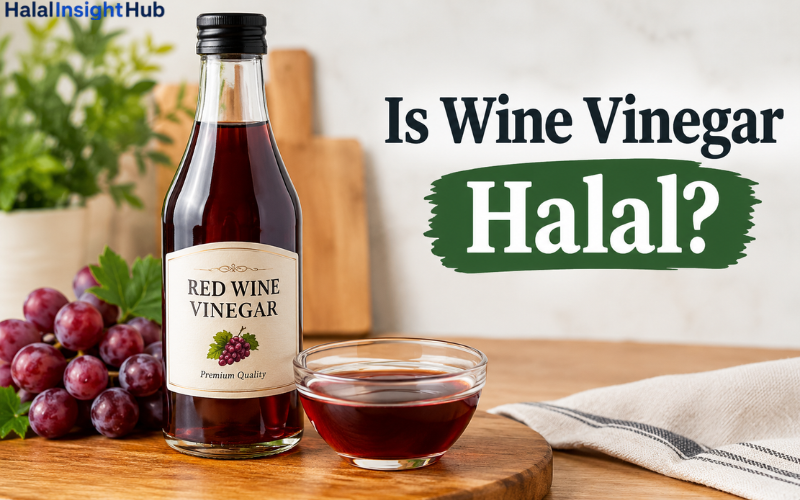
Is wine vinegar halal or haram? Yes, wine vinegar is generally considered halal by many Islamic scholars once the wine has completely transformed into vinegar and is no longer an intoxicating alcoholic drink. This transformation is commonly discussed in Islamic jurisprudence as istihalah. However, scholars differ over whether vinegar remains permissible when wine is deliberately converted into vinegar through a controlled process.
For Muslims buying commercial red wine vinegar or white wine vinegar, the key question is not simply whether the product originally came from wine. It is whether the final product has genuinely become vinegar and whether any impermissible ingredients or alcohol have been added afterward.
Quick Answer
Yes — wine vinegar is generally halal when the original wine has fully transformed into vinegar.
Although wine itself is haram because it is an intoxicating drink, vinegar is a different substance. Several Islamic authorities permit wine vinegar after the transformation into vinegar, including Egypt’s Dar Al-Ifta and the International Islamic Fiqh Academy.
There is, however, a scholarly difference concerning deliberately converting wine into vinegar. Some scholars permit the resulting vinegar, while others distinguish between vinegar produced naturally and vinegar produced through deliberate intervention.
For everyday consumers: ordinary commercial wine vinegar that is sold as vinegar and has undergone the vinegar-making process is generally regarded as permissible by many scholars. If you follow a particular madhhab or want to follow the more cautious opinion, consult a trusted scholar.
Wine Vinegar Halal Status at a Glance
| Question | Answer |
| Is wine vinegar halal? | ✅ Generally yes after complete transformation into vinegar |
| Is wine halal? | ❌ No, intoxicating wine is haram |
| Does wine vinegar still count as wine? | Generally no, when genuine transformation has occurred |
| Is red wine vinegar halal? | ✅ Generally considered halal by many scholars |
| Is white wine vinegar halal? | ✅ Generally considered halal by many scholars |
| Is vinegar made from alcohol halal? | ✅ Many Islamic authorities permit it after transformation |
| Is there scholarly disagreement? | ⚠️ Yes, particularly concerning deliberate conversion |
What Is Wine Vinegar?
Wine vinegar is vinegar produced from wine through a process called acetification. During this process, the alcoholic liquid undergoes chemical and biological changes and becomes acidic vinegar.
This is important from an Islamic perspective because wine and vinegar have very different properties.
Wine is an intoxicating beverage, while vinegar is a sour acidic condiment that does not function as an intoxicating drink.
That transformation is the foundation of the Islamic discussion surrounding wine vinegar.
Related Post: Is Dr Pepper Halal or Haram for Muslims?
Why Is Wine Haram but Wine Vinegar Can Be Halal?
The fact that wine can become vinegar may initially seem confusing.
If wine is haram, why would vinegar made from wine be permissible?
The answer lies in transformation.
Islamic jurisprudence recognizes that a substance can sometimes undergo a substantial transformation and acquire a different ruling. This principle is commonly discussed under istihalah.
Once the original intoxicating characteristics have disappeared and the substance has become vinegar, many scholars no longer treat the final product as wine.
Egypt’s Dar Al-Ifta explains that when an intoxicating liquid transforms into vinegar, the resulting vinegar is lawful, whether the transformation occurs naturally or through manufacturing.
The International Islamic Fiqh Academy has likewise stated that there is no objection to using vinegar made from alcohol.
What Does Islam Say About Vinegar?
Vinegar itself has a positive place in Islamic tradition.
Jabir ibn Abdullah reported that the Prophet Muhammad ﷺ asked his family for a condiment and was told that they had vinegar. The Prophet ﷺ ate it and praised vinegar. This narration is recorded in Sahih Muslim and is frequently cited by scholars discussing the permissibility of vinegar.
This does not mean that wine itself becomes automatically permissible. Rather, the discussion concerns what happens when the original substance has genuinely transformed into vinegar.
Is Red Wine Vinegar Halal?
Yes, red wine vinegar is generally considered halal by many Islamic scholars.
Red wine vinegar starts with red wine, but the manufacturing process converts the alcoholic liquid into vinegar.
Several Hanafi scholars explicitly permit red wine vinegar after this transformation. A Hanafi ruling from Darul Ifta also states that both white wine vinegar and red wine vinegar are halal because the chemical process removes the characteristics that make alcohol impermissible.
However, Muslims should still check the product label because flavored or specialty vinegars can contain additional ingredients.
Is White Wine Vinegar Halal?
Yes, white wine vinegar is generally regarded as halal after the wine has transformed into vinegar.
The same principle applies to white wine vinegar as to red wine vinegar.
A Darul Ifta Birmingham ruling explains that the vinegar-making process involves oxidation that changes alcohol into acetic acid, removing its intoxicating nature. Based on this transformation, the ruling permits foods containing white wine vinegar.
Therefore, seeing the words “white wine vinegar” on an ingredient list does not automatically mean that the food is haram.
Red Wine Vinegar vs White Wine Vinegar
| Type | General Ruling | What to Check |
| Red Wine Vinegar | ✅ Generally halal | Added ingredients |
| White Wine Vinegar | ✅ Generally halal | Added alcohol or flavorings |
| Balsamic Vinegar | ✅ Generally halal | Ingredients and production |
| Apple Cider Vinegar | ✅ Halal | Added ingredients |
| Distilled Vinegar | ✅ Halal | Flavorings and additives |
| Flavored Vinegar | ⚠️ Check label | Alcohol, flavorings, additives |
The important point is that the word “wine” in the name does not by itself determine the ruling of the final product.
Is Wine Vinegar Halal According to the Hanafi School?
The Hanafi school generally has a permissive position regarding vinegar resulting from wine.
Hanafi scholars discuss the concept of transformation and generally regard wine that has become vinegar as permissible. Some Hanafi authorities also allow deliberate conversion of wine into vinegar.
This is why many Muslims following the Hanafi madhhab consider commercially available wine vinegar permissible.
However, consumers should still distinguish between vinegar and products that merely contain alcohol or wine without undergoing the same transformation.
What About the Shafi’i and Hanbali Views?
The discussion is more nuanced in the Shafi’i and Hanbali schools when wine is deliberately converted into vinegar.
A commonly cited position is that if wine becomes vinegar naturally, it is permissible. However, deliberately treating wine to turn it into vinegar has been regarded differently by scholars.
This means there can be a difference between:
Natural transformation:
Wine changes into vinegar without deliberate intervention.
Deliberate transformation:
A person intentionally treats wine to make it become vinegar.
Some scholars permit the final vinegar, while others object to the deliberate process used to produce it.
For consumers purchasing ordinary commercial vinegar, this distinction can become complicated because manufacturing methods are not always obvious from the label.
Scholarly Views on Wine Vinegar
| View | General Position |
| Wine naturally becomes vinegar | Generally considered permissible |
| Wine deliberately converted into vinegar | Scholars differ |
| Hanafi position | Generally permissive after transformation |
| Contemporary fatwa authorities | Many permit vinegar after transformation |
| Wine that remains wine | ❌ Haram |
This difference is important because it prevents us from giving an unnecessarily absolute answer.
Is Wine Vinegar Haram Because It Comes From Alcohol?
No, the source alone does not necessarily make the final vinegar haram.
This is one of the most common misunderstandings about wine vinegar.
The ruling depends on what the final substance actually is. If the alcohol has undergone the vinegar-making process and the product has become vinegar, many scholars regard the final substance as permissible. The International Islamic Fiqh Academy specifically states that vinegar made from alcohol may be used.
Therefore, Muslims should not automatically treat every product containing the words “wine vinegar” as equivalent to wine.
Does Wine Vinegar Contain Alcohol?
The manufacturing process changes alcohol into acetic acid, which is responsible for vinegar’s characteristic sour taste.
Commercial vinegar may contain extremely small residual amounts of alcohol depending on the production method and product. However, the presence of a negligible amount does not automatically make the product equivalent to an intoxicating alcoholic beverage.
Egypt’s Dar Al-Ifta specifically addresses this point and states that a negligible amount of alcohol in vinegar does not make it unlawful because the resulting product is not intoxicating.
For Muslims who follow stricter standards regarding residual alcohol, checking for halal certification can provide additional reassurance.
Can Muslims Eat Food Containing Wine Vinegar?
Generally, yes.
Food containing wine vinegar can be halal when the vinegar itself has undergone the required transformation and the other ingredients in the food are halal.
For example, wine vinegar may appear in:
- Salad dressings
- Pickles
- Marinades
- Sauces
- Mustard
- Pasta sauces
- Dips
However, the entire product should be considered rather than focusing on one ingredient.
A salad dressing could contain halal wine vinegar but also contain another questionable ingredient. Therefore, always check the complete ingredient list.
What Should Muslims Check on a Wine Vinegar Label?
| Label/Ingredient | What It Means |
| Wine vinegar | Generally permissible after transformation |
| Red wine vinegar | Generally permissible after transformation |
| White wine vinegar | Generally permissible after transformation |
| Alcohol added after production | ⚠️ Requires further investigation |
| Wine | ❌ Haram as an intoxicating beverage |
| Alcoholic flavoring | ⚠️ Check source and ruling |
| Halal-certified vinegar | ✅ Strongest consumer assurance |
The safest approach is to look at the entire ingredient list, not just the product name.
Is Balsamic Vinegar Halal?
Balsamic vinegar is generally considered halal when it has undergone the vinegar-making process and contains no impermissible ingredients.
However, balsamic products can vary significantly. Some contain grape must, wine vinegar, sweeteners, flavorings, or other ingredients.
Because formulations differ between brands, Muslims should check the label before purchasing.
The general ruling on vinegar applies, but individual ingredients still matter.
Is Cooking With Wine Vinegar Halal?
Yes, cooking with wine vinegar is generally considered permissible according to many Islamic authorities.
Egypt’s Dar Al-Ifta has specifically addressed the use of red wine vinegar and white wine vinegar in cooking and considers them lawful after transformation into vinegar.
This is different from cooking directly with wine.
Wine and wine vinegar should not be treated as the same ingredient.
Wine vs Wine Vinegar: What’s the Difference?
| Feature | Wine | Wine Vinegar |
| Intoxicating drink | Yes | No |
| Islamic ruling | ❌ Haram | ✅ Generally halal after transformation |
| Main characteristic | Alcoholic | Acidic |
| Used as beverage | Yes | No |
| Used as condiment | Not permissible | Generally permissible |
This distinction is the key to understanding why the ruling can change after transformation.
How to Choose Halal Wine Vinegar
If you want to be extra cautious when buying wine vinegar, follow these steps:
1. Read the Ingredient List
Check whether the product contains only vinegar and permissible ingredients.
2. Look for Halal Certification
A recognized halal certification can provide additional confidence.
3. Check for Added Alcohol
Make sure alcohol has not been added separately after the vinegar-making process.
4. Avoid Confusing Wine With Wine Vinegar
A product labeled wine is not the same as a product labeled wine vinegar.
5. Follow Your Madhhab
If you follow a specific school of Islamic jurisprudence, use its guidance regarding deliberately produced wine vinegar.
“I hope you learned a lot from this article. Check out more articles like this.”
- Is Olive Garden Halal or Haram for Muslims?
- Is Whey Halal or Haram for Muslims?
- Is Crab Halal or Haram for Muslims?
- Is Tyson Chicken Halal or Haram for Muslims?
- Is Swedish Fish Halal or Haram for Muslims?
FAQs
Is wine vinegar halal in Islam?
Yes, wine vinegar is generally considered halal by many Islamic scholars after the original wine has transformed into vinegar and is no longer an intoxicating beverage.
Is red wine vinegar halal?
Yes, many scholars consider red wine vinegar halal after the wine has completely transformed into vinegar. Several Hanafi authorities explicitly permit it.
Is white wine vinegar halal?
Yes. White wine vinegar is generally considered permissible by many scholars when the alcohol has transformed into vinegar.
Is vinegar made from alcohol halal?
Many Islamic authorities permit vinegar made from alcohol after the alcohol has been transformed into vinegar. The International Islamic Fiqh Academy states that there is no objection to using vinegar made from alcohol.
Is balsamic vinegar halal?
Generally, yes, but check the ingredients because balsamic products can contain different additives and flavorings.
Can Muslims eat salad dressing containing wine vinegar?
Generally yes, provided the wine vinegar has transformed into vinegar and the remaining ingredients are halal. Egypt’s Dar Al-Ifta specifically ruled that salad dressing containing white wine vinegar is lawful.
Is cooking with wine vinegar halal?
Generally yes. Many scholars and contemporary Islamic authorities permit the use of wine vinegar in cooking after its transformation into vinegar.
Why is wine haram but wine vinegar halal?
Wine is an intoxicating alcoholic drink, while vinegar is a different acidic substance produced after a transformation process. Islamic scholars discuss this under the principle of istihalah.
Do all scholars agree that wine vinegar is halal?
Not on every aspect. There is scholarly agreement on the permissibility of vinegar that naturally results from wine turning into vinegar, while there is disagreement concerning deliberate conversion of wine into vinegar.
Related Post: Is Root Beer Halal or Haram for Muslims?
Conclusion
So, is wine vinegar halal? In general, yes. Wine vinegar is considered halal by many Islamic scholars once the original wine has completely transformed into vinegar and is no longer an intoxicating substance. Major contemporary Islamic authorities, including Egypt’s Dar Al-Ifta and the International Islamic Fiqh Academy, support the permissibility of vinegar produced through this transformation.
The main point Muslims should understand is that wine and wine vinegar are not automatically treated as the same substance. The transformation from an intoxicating alcoholic liquid into acidic vinegar is central to the ruling.
There is, however, a genuine scholarly difference concerning the deliberate conversion of wine into vinegar. Hanafi scholars generally take a more permissive position, while some Shafi’i and Hanbali scholars place conditions on how the transformation occurs.
For everyday shopping, Muslims can generally consider ordinary red wine vinegar and white wine vinegar permissible when they have undergone genuine transformation into vinegar and do not contain additional impermissible ingredients. If you follow a particular madhhab or prefer the more cautious approach, consult a qualified scholar regarding the production method of a specific product.
In short: wine is haram, but wine that has genuinely transformed into vinegar is generally halal.

Pingback: Is Pepperoni Halal or Haram for Muslims? -
Pingback: Is Marshmallows Halal or Haram for Muslims? -