
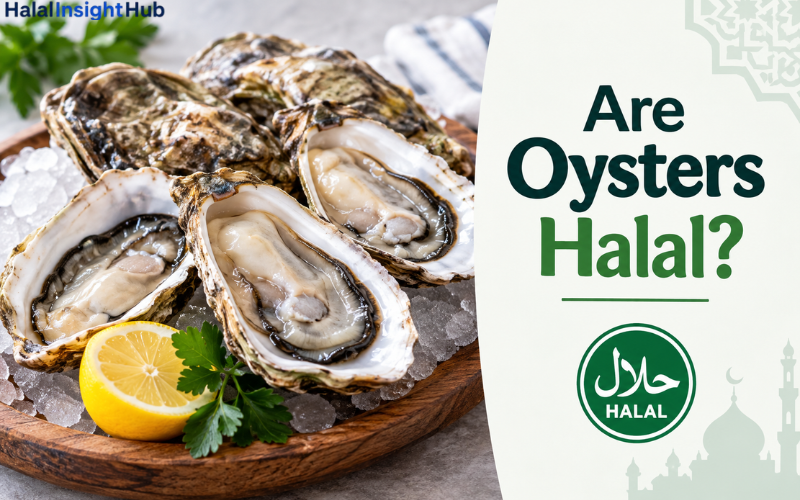
Is oysters halal or haram? Yes, oysters are generally considered halal in Islam. The majority of Islamic scholars permit eating oysters because they are sea creatures and fall under the general permissibility of seafood. Muslims following the Shafi’i, Maliki, and Hanbali schools generally consider oysters halal.
However, there are some differences among Islamic schools regarding certain types of seafood, particularly within the Hanafi school. Therefore, Muslims who follow a specific madhhab may wish to follow the guidance of a trusted scholar.
For most Muslims, plain oysters are considered a permissible seafood choice as long as they are prepared without haram ingredients.
Quick Answer
Yes, oysters are halal for the majority of Muslims.
Oysters are aquatic animals that live in the sea, and the Quran provides a general allowance for food obtained from the sea. Because oysters are not prohibited by name in the Quran or authentic Sunnah, most scholars consider them permissible to eat.
The main difference comes from how different Islamic schools classify and regulate seafood. If you follow the Hanafi school, you may encounter a more cautious discussion about shellfish and other non-fish seafood.
Oyster Halal Status at a Glance
| Question | Answer |
| Are oysters halal? | ✅ Yes, according to the majority of scholars |
| Are oysters mentioned by name in the Quran? | ❌ No |
| Can Muslims eat raw oysters? | ✅ Generally yes, if safe and free from haram ingredients |
| Are oysters halal according to Shafi’i scholars? | ✅ Yes |
| Are oysters halal according to Maliki scholars? | ✅ Yes |
| Are oysters halal according to Hanbali scholars? | ✅ Yes |
| Are oysters halal according to Hanafi scholars? | ⚠️ Scholarly differences exist |
What Are Oysters?
Oysters are marine shellfish that live in saltwater environments. They are commonly found in coastal waters and are eaten in many different ways around the world.
People may eat oysters:
- Raw
- Grilled
- Fried
- Baked
- Steamed
- In soups and seafood dishes
Oysters are also used in sauces and other processed foods.
Because oysters are classified as shellfish rather than fish, some Muslims wonder whether they are permissible under Islamic dietary laws.
The answer depends partly on the Islamic school of thought being followed.
What Does the Quran Say About Seafood?
The Quran gives Muslims important guidance regarding food from the sea.
Allah says:
“Lawful to you is game from the sea and its food as provision for you and the travelers.”
(Surah Al-Ma’idah 5:96)
This verse is an important basis for the general permissibility of seafood in Islamic law.
Oysters live in the sea, so the majority of scholars include them among the seafood that Muslims are permitted to consume.
The Quran does not specifically name oysters as haram. Therefore, there is no direct Quranic prohibition against eating them.
Related Posts: Is Catfish Halal or Haram for Muslims?
What Does the Hadith Say About Seafood?
There is also an important hadith concerning seafood.
The Prophet Muhammad ﷺ was asked about performing ablution with seawater. He said:
“Its water is pure and its dead animals are lawful.”
This hadith is reported in collections including Abu Dawud, al-Tirmidhi, and al-Nasa’i.
Scholars use this hadith as evidence that seafood has a special status in Islamic dietary law. Unlike land animals, sea creatures generally do not require the same form of ritual slaughter before being eaten.
This is one reason the majority of scholars permit oysters and other marine animals.
Are Oysters Halal According to the Four Sunni Schools?
The four major Sunni schools do not all approach seafood in exactly the same way.
| Islamic School | Ruling on Oysters | General Explanation |
| Hanafi | ⚠️ Scholarly difference | Seafood is treated more restrictively |
| Shafi’i | ✅ Halal | Sea animals are generally permissible |
| Maliki | ✅ Halal | Seafood is broadly permissible |
| Hanbali | ✅ Halal | Sea animals are generally permissible |
The most important point is that the majority position is that oysters are halal.
Muslims should also remember that differences between recognized schools of Islamic jurisprudence are not unusual. If you follow a particular madhhab, it is reasonable to follow its established guidance.
Are Oysters Halal According to the Hanafi School?
This is where the discussion becomes more detailed.
The Hanafi school traditionally takes a more restrictive approach toward seafood than the other three Sunni schools. Classical Hanafi jurisprudence generally considers fish permissible while treating many other aquatic animals differently.
Because oysters are shellfish and are not considered fish in the ordinary classification, Hanafi scholars have discussed their permissibility separately.
For this reason, Muslims following the Hanafi school may find different scholarly opinions regarding oysters.
If you follow Hanafi fiqh, it is best to ask a qualified Hanafi scholar about the specific type of oyster or oyster product you intend to eat.
Are Oysters Halal According to the Shafi’i School?
Yes.
The Shafi’i school generally considers sea animals permissible to eat. Oysters are therefore regarded as halal.
This broad permissibility is based on the Quranic permission regarding seafood and the relevant hadith concerning sea animals.
As long as oysters have not been prepared with prohibited ingredients, they can generally be consumed by Muslims following the Shafi’i school.
Are Oysters Halal According to the Maliki School?
Yes, oysters are generally considered halal according to the Maliki school.
The Maliki approach is broad regarding seafood and generally permits animals that live in the sea.
Therefore, oysters fall within the category of permissible seafood.
However, preparation still matters. If oysters are cooked with alcohol, pork-derived ingredients, or another prohibited substance, the final dish may not be halal.
Are Oysters Halal According to the Hanbali School?
Yes.
The Hanbali school generally permits sea animals, and oysters are included within this general ruling.
The evidence commonly discussed includes the Quranic permission for seafood and the hadith describing dead sea animals as lawful.
Therefore, oysters are generally considered halal for Muslims following the Hanbali school.
Why Do Muslims Ask Whether Oysters Are Halal?
There are several reasons why Muslims may be unsure about oysters.
First, oysters are shellfish rather than fish. Some Muslims know that Islamic schools differ over certain shellfish and therefore want to know whether oysters are specifically permissible.
Second, oysters are sometimes served raw, which may raise additional questions about Islamic dietary requirements.
Third, processed oyster dishes can contain sauces, alcohol, or other questionable ingredients.
The oyster itself may be halal, while the ingredients used to prepare it may require additional checking.
Are Raw Oysters Halal?
Generally, yes. Raw oysters are considered halal by the majority of Islamic scholars.
Islamic slaughter is not required for sea creatures in the same way it is required for land animals.
However, halal and food safety are two different issues.
Raw oysters can carry harmful bacteria, viruses, or other contaminants if they are improperly harvested or stored. Muslims should therefore consider food safety when consuming raw oysters.
If a person has concerns about the safety or freshness of raw oysters, cooking them thoroughly may be a better choice.
Are Cooked Oysters Halal?
Yes, cooked oysters are generally halal.
Oysters can be:
- Grilled
- Baked
- Fried
- Steamed
- Boiled
The cooking method itself does not make oysters haram.
The main concern is the ingredients used during preparation.
For example, grilled oysters with herbs and permissible seasonings are generally halal. But oysters cooked with wine or another prohibited ingredient would require further consideration.
Are Fried Oysters Halal?
Fried oysters can be halal if the ingredients and cooking process meet halal requirements.
Before ordering fried oysters at a restaurant, Muslims should consider:
- Is the batter halal?
- Does it contain alcohol?
- Is the frying oil shared with pork or other prohibited foods?
- Are the oysters prepared separately?
- Are any non-halal animal-derived ingredients used?
If all ingredients are permissible and there is no significant contamination with prohibited substances, fried oysters can be halal.
Are Oyster Sauce and Oysters the Same Thing?
No.
This is an important distinction.
Oysters themselves are generally halal according to the majority of Islamic scholars. However, oyster sauce is a processed product and needs to be evaluated based on its ingredients.
Some oyster sauces may contain ingredients that Muslims want to investigate, including alcohol-based flavorings or other questionable additives.
Therefore, do not automatically assume that every product labeled “oyster sauce” has the same halal status as fresh oysters.
Check the ingredient list and look for reliable halal certification when available.
Can Muslims Eat Oysters at Restaurants?
Yes, Muslims can generally eat oysters at restaurants, but it is important to check how they are prepared.
A seafood restaurant may serve oysters alongside other foods that are not halal.
For example, oysters might be prepared using:
- Wine-based sauces
- Alcohol-containing marinades
- Shared cooking equipment
- Non-halal meat products
When eating out, ask restaurant staff about the ingredients and preparation method.
If the oysters are plain and the restaurant confirms that no prohibited ingredients are involved, they are generally considered halal according to the majority opinion.
How to Check If an Oyster Dish Is Halal
| What to Check | Why It Matters |
| Ingredients | Prevents consumption of haram additives |
| Cooking Sauce | Some sauces may contain alcohol |
| Cooking Oil | Shared oil can create contamination concerns |
| Halal Certification | Provides additional assurance |
| Preparation Area | Helps identify cross-contamination risks |
Are Oysters Healthy to Eat?
Oysters are not only popular seafood; they also contain several important nutrients.
They can provide:
- Protein
- Zinc
- Vitamin B12
- Iron
- Selenium
- Omega-3 fatty acids
Zinc is particularly abundant in oysters and plays an important role in normal immune function.
However, nutritional value does not determine whether something is halal or haram. The Islamic ruling and the nutritional characteristics of a food are separate questions.
Oyster Nutrition at a Glance
| Nutrient | Potential Benefit |
| Protein | Supports muscle and tissue maintenance |
| Zinc | Supports normal immune function |
| Vitamin B12 | Supports normal nerve and blood-cell function |
| Iron | Helps with normal oxygen transport |
| Selenium | Supports antioxidant functions |
| Omega-3 Fatty Acids | Important for overall nutrition |
Are Oysters Haram?
No, oysters are not generally considered haram.
The majority of Islamic scholars consider oysters halal because they are sea creatures and fall under the general permissibility of seafood.
However, Muslims following the Hanafi school may encounter a different scholarly discussion because Hanafi jurisprudence has a more restrictive approach to aquatic animals that are not classified as fish.
Therefore, if you follow a particular school of Islamic law, you should follow the guidance of a knowledgeable scholar from that tradition.
What Should Muslims Look For When Buying Oysters?
If you want to purchase oysters for home consumption, plain fresh or frozen oysters are usually the simplest option.
Before buying processed oyster products, check:
- The ingredient list
Look for alcohol, pork-derived ingredients, or other questionable additives. - Halal certification
For processed products, reliable halal certification can provide additional assurance. - Flavorings and sauces
Seasoned oyster products may contain additional ingredients that need to be checked. - Storage and freshness
Seafood should always be stored properly to reduce food-safety risks.
“I hope you learned a lot from this article. Check out more articles like this.”
- Is Octopus Halal or Haram for Muslims?
- Is Catfish Halal or Haram for Muslims?
- Is Crab Halal or Haram for Muslims?
- Is Tyson Chicken Halal or Haram for Muslims?
- Is Swedish Fish Halal or Haram for Muslims?
FAQs
Are oysters halal in Islam?
Yes. The majority of Islamic scholars consider oysters halal because they are sea creatures covered by the general permissibility of seafood.
Are oysters halal according to the Hanafi school?
There is scholarly discussion because the Hanafi school takes a more restrictive approach to seafood that is not classified as fish. Muslims following Hanafi fiqh should consult a qualified scholar for guidance.
Are oysters halal according to Shafi’i scholars?
Yes. Oysters are generally considered halal under the Shafi’i school.
Are oysters halal according to Maliki scholars?
Yes. The Maliki school generally permits sea creatures, including oysters.
Are oysters halal according to Hanbali scholars?
Yes. Oysters are generally permissible according to the Hanbali school.
Can Muslims eat raw oysters?
Yes, raw oysters are generally halal according to the majority opinion. However, Muslims should also consider food safety because raw shellfish can carry harmful microorganisms.
Is oyster sauce halal?
It depends on the ingredients. Oyster sauce should be checked separately because processed sauces may contain alcohol or other questionable ingredients.
Are fried oysters halal?
Fried oysters can be halal if the batter, oil, seasonings, and other ingredients are halal and the food is not improperly contaminated with prohibited substances.
Are oysters mentioned in the Quran?
Oysters are not specifically mentioned by name in the Quran. However, the Quran contains a general permission concerning food from the sea in Surah Al-Ma’idah 5:96.
Do oysters need to be slaughtered Islamically?
No. Sea creatures generally do not require the same ritual slaughter as land animals.
Related Posts: Is Octopus Halal or Haram for Muslims?
Conclusion
So, are oysters halal? Yes, oysters are generally considered halal by the majority of Islamic scholars.
The Shafi’i, Maliki, and Hanbali schools generally permit oysters because they are sea creatures covered by the broad permissibility of seafood. The Hanafi school has a more detailed discussion about non-fish aquatic animals, so Muslims following Hanafi jurisprudence may wish to consult a trusted scholar.
For most Muslims, plain oysters are a permissible seafood choice. However, the preparation still matters. Oyster dishes containing alcohol, questionable sauces, or other haram ingredients should be avoided.
If you are buying processed oyster products or eating oysters at a restaurant, checking the ingredients and preparation method is a simple way to make a more informed halal choice.


Pingback: Is Oreos Halal or Haram for Muslims? -
Pingback: Are Haribo Gummy Bears Halal or Haram for Muslims? -