
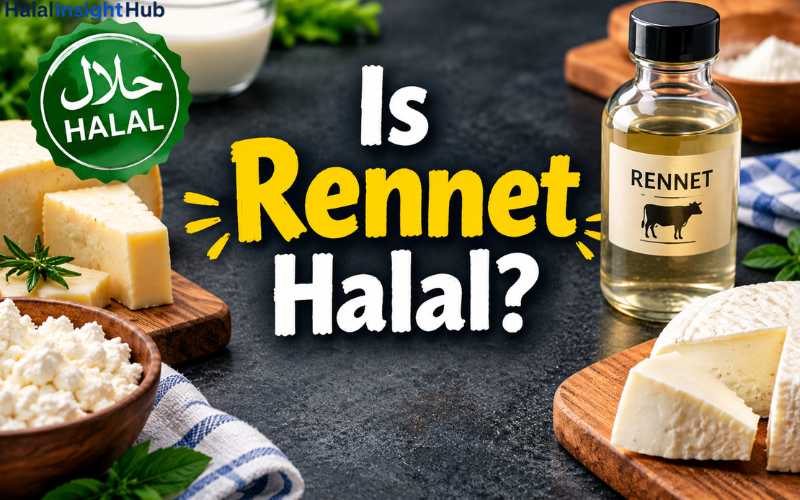
Is Rennet Halal or Haram? Rennet can be halal or haram depending on its source and the Islamic ruling a person follows. Microbial and plant-based rennet are generally considered halal, provided the ingredients and production process meet halal requirements. Animal rennet requires more careful consideration because its status may depend on the animal’s source, slaughter method, and scholarly interpretation.
For Muslims, understanding rennet is especially important when buying cheese, pizza, Parmesan, mozzarella, and other dairy products. Some cheeses use microbial enzymes, while others are made with animal-derived rennet.
If you are unsure about a product, check its halal certification or ask the manufacturer about the source of its rennet before deciding whether it is suitable for your diet.
Quick Answer: Is Rennet Halal or Haram?
Rennet is not automatically halal or haram; its status depends on where it comes from.
- Microbial rennet: Generally halal when its production meets halal requirements.
- Plant-based rennet: Generally halal when the remaining ingredients and process are permissible.
- Animal rennet: Its ruling depends on the animal source and the Islamic interpretation followed.
- Pig-derived rennet: Haram.
- Rennet of unknown origin: Check halal certification or contact the manufacturer.
Islamic scholars differ on some forms of animal rennet obtained from animals that were not slaughtered according to Islamic requirements. Some scholars permit certain non-pig animal rennet, while others consider it impermissible. Muslims should follow a trusted scholar or the halal standard they normally rely on.
Related Posts: Is Five Guys Halal or Haram for Muslims?
What Is Rennet?
Rennet is a group of enzymes used in cheese-making to help milk coagulate and separate into solid curds and liquid whey. The curds are then processed into different types of cheese, including cheddar, mozzarella, and many hard cheeses.
Traditionally, rennet was obtained from the stomach lining of young animals, especially calves. Today, manufacturers can also use microbial, plant-based, and fermentation-produced enzymes.
Rennet is important because it helps give cheese its texture, structure, and consistency. However, not every cheese uses the same type.
For Muslim consumers, the main question is whether the rennet and the complete production process comply with Islamic dietary requirements.
Types of Rennet and Their Halal Status
| Type of Rennet | Source | General Halal Status |
|---|---|---|
| Animal rennet | Stomach lining of animals | Depends on source and scholarly ruling |
| Microbial rennet | Microorganisms such as fungi | Generally halal if production requirements are met |
| Plant-based rennet | Certain plants, including thistles | Generally halal if other requirements are met |
| Fermentation-produced enzymes | Enzymes produced through fermentation | Generally halal-compatible when ingredients and processing comply |
| Pig-derived rennet | Pigs | Haram |
These are general guidelines, not a certification of any specific product. When a label does not explain the source, reliable halal certification or manufacturer confirmation is the best way to investigate.
Is Animal Rennet Halal?
Animal rennet is the type that raises the most questions among Muslim consumers.
Traditional animal rennet is extracted from the stomach lining of animals such as calves, sheep, and goats. The halal ruling can depend on the animal involved and how it was slaughtered.
According to one widely followed scholarly position, rennet from an animal slaughtered according to Islamic requirements is permissible. Some scholars take a stricter view of rennet from animals that were not slaughtered according to Islamic law, while other scholars permit certain non-pig animal rennet under specified conditions.
This difference of opinion means that animal rennet should not be labelled universally halal or universally haram without explaining the relevant circumstances.
If you follow a particular madhhab, ask a trusted scholar about the ruling you should apply. You can also look for cheese made with verified microbial rennet or a valid halal certification if you want to avoid uncertainty.
Is Microbial Rennet Halal?
Yes, microbial rennet is generally considered halal because it is produced using microorganisms rather than extracted directly from an animal’s stomach.
It is widely used as an alternative to traditional animal rennet in modern cheese production. However, the overall halal status still depends on the production process, including any relevant ingredients, processing aids, or carriers.
For Muslims who want to avoid questions about animal slaughter, microbial rennet can be a practical option.
When shopping, look for terms such as “microbial enzymes” or “microbial rennet” on the ingredient label. If the wording is unclear, contact the manufacturer or look for halal certification.
Is Plant-Based Rennet Halal?
Plant-based rennet is generally halal because it comes from plants rather than animal stomachs.
Some plants contain enzymes that can coagulate milk and help produce cheese. Certain thistles and fig plants are examples of sources used for plant-based coagulants.
For Muslim consumers, this type of rennet generally avoids the main concerns associated with animal-derived rennet. However, the other ingredients and the manufacturing process must still meet halal requirements.
Do not confuse “plant-based rennet” with a guarantee that every ingredient in a cheese product is halal. Always check the complete ingredient list and any available certification.
Is Pig-Derived Rennet Halal?
No. Rennet obtained from pigs is considered haram under Islamic dietary rules.
Pork and its prohibited derivatives are not made permissible simply because they are used in food manufacturing. If a manufacturer confirms that a cheese product contains pig-derived rennet, Muslims should avoid it.
However, do not assume that all animal rennet comes from pigs. Animal rennet is commonly obtained from calves or other ruminants, so the exact source must be verified when it is not stated on the label.
If the source is unknown, ask the manufacturer rather than guessing.
Is Rennet in Cheese Halal?
Cheese can be halal when its ingredients, rennet source, and production process meet Islamic dietary requirements.
Some cheeses are made using microbial or plant-based rennet, while others use animal-derived enzymes. This is why two cheeses that look similar may have different halal statuses.
Cheese Types and What to Check
| Cheese Type | What Muslims Should Check |
|---|---|
| Mozzarella | Rennet source and halal certification |
| Cheddar | Enzymes or rennet listed in the ingredients |
| Parmesan | Whether traditional animal rennet is used |
| Pizza cheese | Rennet source in the cheese blend |
| Cream cheese | Ingredients and any added enzymes |
| Processed cheese | Complete ingredient list and certification |
These examples do not mean that a particular cheese is halal or haram simply because of its name. Recipes vary by brand and country, so check the exact product.
Why Does Rennet Matter for Muslims?
Rennet matters because it is used in the production of many cheeses, and its source may not be obvious from the finished product.
A cheese package may list “enzymes” or “rennet” without specifying whether those enzymes are animal-derived, microbial, or plant-based. This can make it difficult for consumers to establish halal status from the ingredient list alone.
There are three main things to consider:
1. The Source of the Enzyme
The first step is to determine whether the rennet comes from an animal, microorganism, or plant. If it is animal-derived, additional details may be needed.
2. The Islamic Ruling
Scholars differ on certain forms of animal rennet, particularly when the animal was not slaughtered according to Islamic requirements. Following a trusted scholar can help you make a decision consistent with your beliefs.
3. The Complete Product
Rennet is not the only ingredient that matters. Other additives, processing aids, and manufacturing practices may also be relevant to halal compliance.
For this reason, product-specific halal certification can be more helpful than relying on the word “rennet” alone.
How to Check If Rennet Is Halal
Here are practical steps to help you check a cheese product before buying it.
Look for Halal Certification
Check the packaging for a halal logo or certificate from a trustworthy certification body. Make sure the certification applies to the exact product.
Read the Ingredient Label
Look for terms such as “animal rennet,” “microbial rennet,” “vegetarian rennet,” or “enzymes.” Remember that a general term such as “enzymes” may not reveal the source.
Contact the Manufacturer
If the label does not provide enough information, ask the manufacturer whether the rennet is animal-derived, microbial, or plant-based. If it is animal-derived, ask for further information relevant to the halal standard you follow.
Check the Product You Are Buying
Do not assume every product from the same brand has identical ingredients. Formulations and suppliers may vary between products and markets.
Common Signs That Rennet Needs Further Verification
| Label or Product Detail | What It Means |
|---|---|
| Halal certification from a trusted body | Useful evidence of compliance |
| “Microbial rennet” | Generally halal-compatible |
| “Vegetarian rennet” | Generally avoids animal-derived rennet; check other ingredients |
| “Animal rennet” | Further source information may be needed |
| “Enzymes” without details | Source may be unclear |
| Manufacturer confirms pig-derived rennet | Not halal |
A label that does not specify the source does not automatically prove that the product is haram. It means you may need more information to make a decision that meets your own halal requirements.
Can Muslims Eat Cheese Made With Animal Rennet?
There is a difference of opinion among Islamic scholars regarding some cheese made with animal rennet from animals that were not slaughtered according to Islamic requirements.
Some scholars consider such rennet impermissible, while others permit certain non-pig animal rennet. For example, the International Islamic Fiqh Academy has issued a ruling permitting rennet from permissible animals under specified conditions, including certain animals not slaughtered according to Shariah, while excluding rennet from impermissible animals such as pigs.
Because the ruling depends on the circumstances and scholarly interpretation, Muslims should not assume that all animal rennet has one universally accepted status.
If you prefer the more cautious option, choose cheese with reliable halal certification or a verified microbial or plant-based rennet source.
“I hope you learned a lot from this article. Check out more articles like this.”
- Is Five Guys Halal or Haram for Muslims?
- Is Parmesan cheese Halal or Haram for Muslims?
- Is Sugar Alchohol Halal or Haram for Muslims?
- Is Kosher Halal or Haram for Muslims?
- Is Turkey Bacon Halal or Haram for Muslims?
FAQs
Is rennet halal or haram?
Rennet can be halal or haram depending on its source and the Islamic ruling followed. Microbial and plant-based rennet are generally halal, while animal rennet may require further verification.
Is animal rennet halal in Islam?
Animal rennet from animals slaughtered according to Islamic requirements is generally considered permissible. Scholars differ on some rennet from animals not slaughtered according to Islamic law.
Is microbial rennet halal?
Microbial rennet is generally halal because it is produced using microorganisms. The other ingredients and production process must also meet halal requirements.
Is vegetarian rennet halal?
Vegetarian rennet is generally suitable for halal diets because it avoids animal-derived rennet. However, the complete cheese product must still meet halal requirements.
Is pig rennet halal?
No. Pig-derived rennet is considered haram under Islamic dietary rules.
Is cheese made with animal rennet haram?
Not necessarily. Its status depends on the animal source and the Islamic interpretation followed. Some scholars permit certain non-pig animal rennet, while others apply stricter requirements.
How can I tell if cheese contains halal rennet?
Look for halal certification, check the ingredient label, or contact the manufacturer to ask about the rennet source.
Is rennet halal according to the Hanafi school?
Some Hanafi scholars permit rennet from permissible animals even when they were not slaughtered according to Islamic requirements, while other scholarly discussions raise concerns about impurity. For a ruling that applies to your situation, consult a trusted Hanafi scholar.
Related Posts: Is Five Guys Halal or Haram for Muslims?
Conclusion
Rennet can be halal, but its status depends on the source and the requirements followed by the consumer. Microbial and plant-based rennet are generally considered halal when the other ingredients and manufacturing process are also permissible. Animal rennet requires more care because Islamic scholars differ on certain sources, particularly when the animal was not slaughtered according to Islamic requirements.
Pig-derived rennet is haram, while the ruling on non-pig animal rennet can depend on the circumstances and the scholarly view followed.
If you want to make an informed choice, check the ingredient label, look for reliable halal certification, and contact the manufacturer whenever the source is unclear. Choosing a verified product can help you avoid unnecessary uncertainty when buying cheese, pizza, and other dairy foods.


Pingback: Is Nerds Gummy Clusters Halal or Haram for Muslims? -