
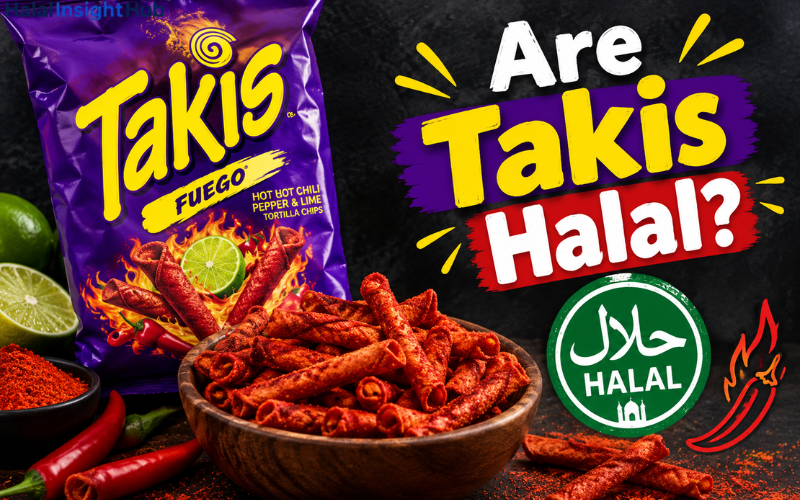
Are Takis halal or haram? The answer depends on the specific Takis flavor, its ingredients, and the country where it is sold. Some Takis products may be suitable for Muslims, while others require careful ingredient checks because seasonings, flavorings, and other additives can vary by product.
Takis are popular rolled tortilla chips known for their intense spicy flavor and crunchy texture. Many Muslims enjoy spicy snacks but want to make sure the food they eat follows Islamic dietary guidelines. Unfortunately, a product’s popularity or its lack of obvious pork ingredients does not automatically mean it is halal.
To determine whether Takis are halal, you need to examine the ingredient list, check for reliable halal certification, and consider whether any questionable ingredients come from animal sources.
In this guide, we will explain which ingredients matter, how to check different Takis flavors, and what Muslims should know before eating these popular spicy chips.
Quick Answer: Are Takis Halal or Haram?
Takis are not automatically halal or haram. Their halal status depends on the specific product, its ingredients, and whether reliable halal certification is available.
Some Takis varieties may contain ingredients that are generally considered permissible, while others may include flavorings or additives whose sources are not clearly identified on the package.
Here is a simple overview:
| Question | Answer |
| Are all Takis halal? | No, not automatically |
| Are all Takis haram? | No, not automatically |
| Are Takis Fuego halal? | Check the exact product and market-specific ingredients |
| Can Muslims eat Takis? | Yes, if the product meets their halal requirements |
| Is halal certification helpful? | Yes, it provides stronger assurance |
| Should ingredients be checked? | Yes, especially when certification is unclear |
If you follow a strict halal diet, do not assume that every Takis flavor is halal simply because it does not list pork as an ingredient. Check the package and look for reliable certification before deciding.
What Are Takis?
Takis are rolled tortilla chips produced by Barcel, a snack brand associated with Grupo Bimbo. They are widely recognized for their distinctive tube-like shape, crunchy texture, and bold seasonings.
The brand offers several flavors, including spicy chili and lime varieties, cheese-based options, and other intensely seasoned snacks. Availability differs by country, and products sold in the United States may not have precisely the same ingredients as products sold elsewhere.
Takis generally contain a corn-based chip along with vegetable oils, seasonings, and flavoring ingredients. Depending on the variety, the seasoning may include chili pepper, salt, acids, cheese ingredients, flavor enhancers, and other additives.
These ingredients are important because the basic corn chip is not usually the main halal concern. Instead, the seasoning and the sources of certain additives may require closer examination.
Related Posts: Is Twizzlers Halal or Haram for Muslims?
Why Do Muslims Question Whether Takis Are Halal?
Muslims examine Takis because packaged snacks can contain ingredients whose origins are not immediately obvious. Even when a product contains no visible meat, its flavoring ingredients may require further investigation.
There are three main reasons to check Takis before eating them.
1. Flavorings and Seasonings
Seasoning blends can contain multiple ingredients, including natural flavors, artificial flavors, flavor enhancers, acids, and other additives.
Many of these ingredients are permissible in principle. However, a general term such as “natural flavors” may not reveal every detail about the source or manufacturing process.
This does not mean that natural flavors are automatically haram. It means that if the source is unclear and halal certification is unavailable, further verification may be necessary.
2. Dairy-Based Ingredients
Some Takis varieties use cheese or other dairy-related ingredients. Ordinary milk and cheese ingredients are not automatically haram, but their processing and sources can matter.
For example, certain cheese ingredients may be produced using enzymes. If an enzyme is derived from an animal, its source and the relevant Islamic slaughter requirements may affect the halal assessment.
This concern applies only where such ingredients are present. It should not be assumed that every Takis variety contains animal-derived enzymes.
3. Different Formulas in Different Countries
A Takis product sold in one country may differ from a similarly named product sold in another country.
Manufacturers may adjust seasoning blends, ingredients, suppliers, and labeling to meet local requirements. Halal certification may also differ between markets.
Therefore, a statement about one package should not automatically be applied to every Takis product worldwide.
Are Takis Fuego Halal?
Takis Fuego is one of the most popular Takis flavors. It combines spicy chili seasoning with a tangy lime flavor, making it a favorite among people who enjoy hot snacks.
The US ingredient list for Takis Fuego includes corn flour, vegetable oil, maltodextrin, citric acid, sugar, monosodium glutamate, hydrolyzed soy protein, onion powder, yeast extract, natural and artificial flavors, and other additives.
Most of these ingredients are generally considered halal when their sources and processing are permissible. However, two ingredients deserve closer attention:
- Disodium inosinate (E631): This flavor enhancer can be produced from animal or non-animal sources. Its source matters when determining halal status.
- Disodium guanylate (E627): This flavor enhancer may also come from different sources, so its origin can be relevant to halal verification.
These additives are not automatically haram. However, when their sources are undisclosed, the ingredient list alone may not settle the question for Muslims who require clear halal assurance.
Takis Fuego has also received product-specific approval from the Halal Monitoring Authority in Canada. This shows why it is important to distinguish between particular products, certification authorities, and markets rather than treating every Takis product as having the same status.
Verdict: Check the exact Takis Fuego package you intend to buy. If it carries a valid halal certification from a trusted authority, that provides stronger assurance. Without certification or confirmation of questionable ingredient sources, some Muslims may prefer to avoid it.
Are Takis Blue Heat Halal?
Takis Blue Heat is another popular variety known for its bright blue color and spicy taste. Its distinctive appearance comes from food coloring, while its seasoning provides the characteristic heat.
The halal status of Blue Heat depends on its complete ingredient list and the sources of its additives.
Ingredients such as corn flour, vegetable oil, salt, and many common flavoring ingredients are generally permissible. However, flavor enhancers such as disodium inosinate and disodium guanylate may require further verification when their sources are not disclosed.
The blue coloring itself is not automatically a halal concern simply because it is artificial. Artificial colors are generally permissible unless there is a specific issue with their ingredients or production.
Verdict: Takis Blue Heat should not automatically be classified as halal or haram. Check the package, look for recognized halal certification, and verify the sources of any questionable additives.
Are Other Takis Flavors Halal?
Takis offers more than just Fuego and Blue Heat. Different flavors can have different seasonings, which means their halal status may also differ.
Here is a general guide to some popular varieties.
| Takis flavor | Main consideration | What Muslims should do |
| Takis Fuego | Flavor enhancers and undisclosed sources | Check certification and ingredients |
| Takis Blue Heat | Flavor enhancers and seasoning sources | Verify the exact package |
| Takis Nitro | Seasoning and flavoring ingredients | Check for halal certification |
| Takis Crunchy Fajitas | May contain whey and other seasoning ingredients | Check dairy ingredients and processing |
| Takis Nacho Xplosion | Cheese-related ingredients may require verification | Check the ingredient list |
| Takis Dragon Sweet Chili | Seasoning and flavor enhancer sources | Verify the specific product |
| Takis Waves | Ingredients can vary by flavor | Check the exact variety |
This table is a general guide, not a definitive certification list. Recipes can change, and products with similar names may have different formulations in different countries.
For example, whey is a milk-derived ingredient that is not automatically haram. However, some dairy ingredients may involve enzymes or processing aids that require further investigation.
Similarly, the presence of a flavor enhancer does not automatically make a snack impermissible. Its source and manufacturing process are what matter.
Which Ingredients in Takis May Raise Halal Concerns?
Understanding food ingredients can help Muslims make more informed decisions about packaged snacks.
Not every unfamiliar ingredient is haram. Some are plant-derived, some are produced through fermentation, and others can come from animal sources. The important question is whether the ingredient and its production comply with Islamic dietary requirements.
1. Disodium Inosinate (E631)
Disodium inosinate is a flavor enhancer used to intensify savory flavors. It is commonly found in seasoned chips, instant noodles, and other processed snacks.
It may be produced from animal sources or through non-animal methods. If it comes from an impermissible animal source, it can raise a halal concern.
The ingredient name alone does not tell consumers which source was used in a particular Takis product.
2. Disodium Guanylate (E627)
Disodium guanylate is another flavor enhancer that contributes to a stronger savory taste.
Like disodium inosinate, it can be produced using different methods and sources. Its presence on an ingredient label does not automatically establish that a product is haram.
When its origin is unclear, halal certification or confirmation from the manufacturer can help resolve the uncertainty.
3. Natural and Artificial Flavors
Natural and artificial flavors are used to create or enhance a product’s taste.
Many flavorings are entirely compatible with halal dietary requirements. Nevertheless, the term “natural flavors” does not always identify every source used in the flavoring mixture.
If the manufacturer does not provide enough information, consumers may need to seek clarification, particularly when following strict halal standards.
4. Whey and Cheese Ingredients
Some seasoned snacks contain whey, cheese powder, or other dairy ingredients.
Milk itself is halal, and many dairy-derived ingredients are permissible. However, certain cheese ingredients may use enzymes whose origins matter for halal compliance.
Muslims should not assume that every cheese-flavored snack is haram. Instead, they should examine the specific ingredients and any relevant certification.
5. Food Colors
Some Takis products contain artificial colors, while others may use colorings derived from plants or other sources.
Artificial coloring is not automatically haram. The assessment depends on the actual substance, its source where relevant, and any applicable processing concerns.
A bright blue or red color does not, by itself, indicate whether a product is halal.
Are Takis Halal in the USA?
Takis products sold in the United States should be assessed according to their US ingredient labels and any certification applicable to the specific product.
The US Takis Fuego ingredient declaration lists several flavor enhancers, including disodium inosinate and disodium guanylate. Their sources are not identified in the standard ingredient list.
This creates a distinction between a product whose listed ingredients appear compatible with halal requirements and one whose halal status has been independently verified.
A product can lack halal certification without necessarily containing a confirmed haram ingredient. Equally, the absence of pork or gelatin on a label does not prove that every ingredient meets halal requirements.
For Muslims living in the United States, the most reliable approach is to check for a recognized halal certification mark and confirm that it applies to the exact product being purchased.
Verdict: Do not assume that all Takis sold in the USA are halal or that all are haram. Verify the specific flavor and package before making a decision.
Are Takis Halal in the UK?
The same principle applies to Takis sold in the United Kingdom.
European product formulations may differ from those sold in the United States. For example, the European Takis Fuego ingredient information lists precooked maize flour, vegetable oils, flavorings, and flavor enhancers, including disodium inosinate and disodium guanylate.
These ingredients require assessment based on their actual sources and production methods when halal status is uncertain.
It is also important to distinguish between a snack being sold in a Muslim-majority market, being imported by a particular distributor, and having valid halal certification. These are not equivalent.
Verdict: Muslims in the UK should check the ingredients and certification on their own package rather than relying on claims about a similarly named product sold elsewhere.
How Can You Check Whether Takis Are Halal?
If you want to determine whether a particular bag of Takis is suitable for your diet, follow these practical steps.
Step 1: Read the Full Ingredient List
Look at the back of the package and review all listed ingredients, including the seasoning blend.
Pay particular attention to flavor enhancers, animal-derived ingredients, and any components whose origins are unclear.
Step 2: Look for a Halal Certification Mark
Check whether the package displays a halal logo from a recognized certification organization.
Do not rely solely on online comments or general statements about the brand. If possible, verify that the certification applies to the exact product and market.
Step 3: Check the Country of Manufacture
Compare the package’s ingredient list with information for the same product sold in that country.
A US version and a European version may have different ingredients or certification status, even when they share the same flavor name.
Step 4: Contact the Manufacturer
If you cannot establish the source of an ingredient, contact the manufacturer and ask specifically about the additives in question.
For Takis, you can ask whether the disodium inosinate and disodium guanylate in your particular product are derived from animal or non-animal sources and whether the product has recognized halal certification.
Step 5: Follow a Trusted Halal Authority
If you follow the guidance of a particular halal certification organization or Islamic scholar, use that authority’s assessment when making your decision.
Different authorities may apply different standards to certain ingredients and production processes. A clear, product-specific assessment is more useful than a blanket claim about the entire brand.
Takis vs. Other Spicy Snacks: Which Is Easier to Verify?
If you enjoy spicy snacks but want to avoid uncertainty, you can compare products based on their ingredient transparency and certification.
| Snack type | Common ingredients | Halal considerations |
| Plain corn chips | Corn, vegetable oil, salt | Usually straightforward, subject to the full ingredients |
| Chili-flavored chips | Corn or potatoes, oil, seasoning | Check flavorings and additives |
| Cheese-flavored chips | Corn or potatoes, cheese seasoning | Check dairy ingredients and enzymes where relevant |
| Halal-certified spicy chips | Depends on the product | Confirm the certification is valid for the exact product |
| Takis rolled tortilla chips | Corn, vegetable oil, seasoning | Verify flavor-specific ingredients and certification |
This comparison does not mean that plain chips are always halal or that seasoned chips are automatically questionable. It simply shows why the complete ingredient list and reliable certification matter.
When choosing a snack, prioritize products that clearly disclose their ingredients and provide the level of halal assurance you require.
Are Takis Safe to Eat Besides the Halal Question?
Halal status and nutritional health are two different questions.
Even if a Takis product meets halal requirements, it may still be high in sodium, spicy seasoning, or fat. Eating large quantities of heavily seasoned chips regularly may not be ideal for a balanced diet.
People who experience heartburn, stomach irritation, or discomfort after eating spicy foods may also want to limit their intake.
For everyday snacking, consider portion size and overall dietary balance rather than treating halal certification as a guarantee that a product is healthy.
“I hope you learned a lot from this article. Check out more articles like this.”
- Is Twizzlers Halal or Haram for Muslims?
- Is Pop-Tarts Halal or Haram for Muslims?
- Is Sour Patch Kids Halal or Haram for Muslims?
- Is Nerds Gummy Clusters Halal or Haram for Muslims?
- Is Rennet Halal or Haram for Muslims?
FAQs
1. Are Takis halal or haram?
Takis do not have one universal halal verdict. Their status depends on the flavor, ingredient sources, country of sale, and applicable certification. Check your exact package before deciding.
2. Are Takis Fuego halal?
Takis Fuego requires product-specific verification. Its ingredient list includes flavor enhancers whose sources may not be disclosed on the package. Check for recognized halal certification or reliable confirmation of those sources.
3. Are Takis Blue Heat halal?
Takis Blue Heat should be assessed using its specific ingredient list and certification status. Do not assume that it is halal simply because it contains no obvious pork ingredient.
4. Do Takis contain pork?
The ingredient lists for some Takis varieties do not explicitly list pork. However, an ingredient label may not disclose the source of every flavor enhancer or flavoring. Contact the manufacturer if you need confirmation about a particular product.
5. Do Takis contain gelatin?
Gelatin is not listed in the US Takis Fuego ingredient declaration discussed in this article. However, ingredients can vary between flavors and markets, so check your own package before applying that conclusion to other Takis products.
6. Are Takis halal in Pakistan?
The answer depends on the specific product imported into Pakistan. Check the package for a valid halal certification and review the ingredients. Do not assume that every imported Takis product has the same certification status.
7. Can Muslims eat Takis if they have no halal logo?
A missing halal logo does not automatically prove that a product is haram. However, if its ingredients include additives of uncertain origin, Muslims who require clear halal assurance may prefer to wait for reliable confirmation.
8. Are all Takis flavors the same?
No. Takis flavors can differ in their seasoning blends, dairy ingredients, additives, and formulations across markets. Each flavor should be evaluated separately.
9. Are artificial flavors haram?
Artificial flavors are not automatically haram. Their permissibility depends on their ingredients, production methods, and compliance with applicable Islamic dietary requirements.
10. What should I do if I am unsure about Takis?
Check the ingredients, look for recognized halal certification, and contact the manufacturer if necessary. If you remain uncertain and prefer to follow a cautious approach, choose a clearly certified alternative.
Related Posts: Is Twizzlers Halal or Haram for Muslims?
Conclusion
So, are Takis halal? The answer depends on the specific flavor, its ingredients, and whether its halal status can be reliably verified.
Many ingredients used in Takis, including corn flour, vegetable oils, and common food additives, can be permissible. However, flavor enhancers such as disodium inosinate and disodium guanylate may require further investigation when their sources are not disclosed.
It is important not to label every Takis product haram without evidence, just as it is important not to assume that every flavor is halal without verification.
If you want the greatest confidence in your choice, check the exact package, look for recognized halal certification, and seek clarification about questionable ingredients when needed.
For Muslims who follow a strict halal diet, choosing a clearly certified snack is often the simplest way to enjoy spicy chips without unnecessary uncertainty.

Pingback: Are Jolly Ranchers Halal or Haram for Muslims? -
Pingback: Is Mcdonald’s Halal or Haram for Muslims? -
Pingback: Are Gushers Halal or Haram for Muslims? -
Pingback: Is Shake Shack Halal or Haram for Muslims? -
Pingback: Is Trident gum Halal or Haram for Muslims? -