
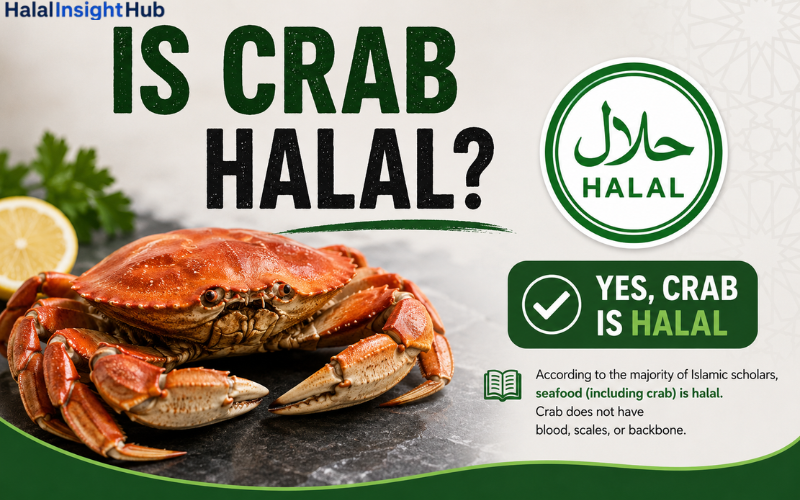
The halal status of crab depends on the Islamic school of thought you follow. According to the Shafi’i, Maliki, and Hanbali schools, crab is generally considered halal because it is a sea creature. However, the Hanafi school has a different opinion, and many Hanafi scholars consider crab not permissible because it is not classified as a fish.
If you follow a particular madhhab, it is best to follow the guidance of your trusted scholars. Since scholarly opinions differ, understanding the evidence behind each view can help you make an informed decision.
Is Crab Halal?
Yes, crab is halal according to the majority of Islamic scholars, but there is a difference of opinion within the Hanafi school.
Most scholars believe that all sea creatures, including crab, are permissible to eat based on the Quran and authentic Hadith. On the other hand, many Hanafi scholars limit permissible seafood mainly to fish and therefore do not consider crab halal.
If you are unsure which opinion to follow, consult your local scholar or Islamic authority.
Crab Halal Status at a Glance
| Question | Answer |
| Is crab halal? | ✅ Yes (majority opinion) |
| Is crab halal in the Hanafi school? | ❌ Generally not |
| Is crab halal in the Shafi’i school? | ✅ Yes |
| Is crab mentioned in the Quran? | ❌ Not by name |
| Can Muslims eat crab? | ✅ Most scholars say yes |
Related Post: Is Shrimp Halal or Haram for Muslims?
What Is Crab?
Crab is a crustacean that lives in oceans, seas, rivers, and coastal waters around the world. It is one of the most popular seafood choices and is used in many cuisines, including Asian, Middle Eastern, and Western dishes.
Unlike fish, crab belongs to the crustacean family and has a hard outer shell with multiple legs. This biological difference is one of the main reasons why Islamic scholars have discussed its halal status in detail.
Today, crab is commonly served as boiled, grilled, steamed, or fried seafood in restaurants worldwide.
What Does the Quran Say About Seafood?
The Quran provides a general permission regarding food from the sea.
Allah says:
“Lawful to you is game from the sea and its food as provision for you and the travelers.”
(Surah Al-Ma’idah 5:96)
This verse is one of the strongest evidences used by Islamic scholars when discussing the permissibility of seafood.
Scholars who consider crab halal explain that it falls under the category of sea creatures mentioned in this verse.
What Does the Hadith Say About Seafood?
The Prophet Muhammad ﷺ also clarified the ruling regarding seafood.
He said:
“Its water is pure, and its dead animals are lawful.”
This authentic Hadith is widely accepted as evidence that sea animals do not require Islamic slaughter like land animals.
The majority of scholars include crab within this general ruling because it naturally lives in the sea.
Is Crab Halal According to the Hanafi School?
The Hanafi school has the most restrictive opinion regarding seafood.
Many Hanafi scholars believe that only fish are permissible to eat from the sea. Since crab is classified as a crustacean rather than a fish, they generally consider it not halal.
Their opinion is based on the traditional Hanafi interpretation of permissible seafood.
However, some contemporary Hanafi scholars have discussed the issue in light of modern biological classifications, though the traditional ruling remains the most widely followed within the Hanafi madhhab.
Muslims who follow the Hanafi school should consult their local scholars for guidance.
Is Crab Halal According to the Shafi’i School?
Yes.
The Shafi’i school considers all sea animals halal unless there is authentic evidence proving otherwise.
Because crab spends its life in water, Shafi’i scholars generally regard it as permissible to eat.
This opinion is followed by millions of Muslims in countries such as Indonesia, Malaysia, Yemen, and parts of East Africa.
Islamic Opinions on Crab
| School of Thought | Ruling on Crab |
| Hanafi | Generally Not Halal |
| Shafi’i | Halal |
| Maliki | Halal |
| Hanbali | Halal |
Is Crab Halal According to the Maliki School?
Yes.
The Maliki school has one of the broadest views regarding seafood. Maliki scholars generally consider all sea creatures halal unless there is clear evidence prohibiting them.
Since crab naturally lives in water, it is considered permissible according to the Maliki madhhab.
Is Crab Halal According to the Hanbali School?
Yes.
Hanbali scholars also permit eating crab.
Based on the Quranic verses and authentic Hadith regarding seafood, they believe crab falls under the general permissibility of sea animals.
As long as the crab is prepared using halal ingredients and is free from contamination with haram substances, it is considered halal according to the Hanbali school.
Countries Where Crab Is Commonly Considered Halal
| Country/Region | Common Islamic Opinion |
| Saudi Arabia | Halal |
| UAE | Halal |
| Malaysia | Halal |
| Indonesia | Halal |
| Pakistan (Hanafi Majority) | Scholarly Difference |
| India (Hanafi Majority) | Scholarly Difference |
Why Do Scholars Differ About Crab?
The difference of opinion about crab comes from how Islamic scholars classify sea animals, not from a disagreement about the importance of eating halal food.
The majority of scholars from the Shafi’i, Maliki, and Hanbali schools believe that all creatures that naturally live in the sea are halal unless there is clear evidence prohibiting them. They base this opinion on the general permission given in the Quran and authentic Hadith regarding seafood.
The Hanafi school, however, traditionally limits permissible seafood mainly to fish. Since crab is a crustacean rather than a fish, many Hanafi scholars do not consider it halal.
This difference is based on Islamic jurisprudence (Fiqh) and centuries of scholarly interpretation. Both opinions are respected within Sunni Islam, and Muslims are encouraged to follow the guidance of their trusted scholars.
Can Muslims Eat Crab?
The answer depends on the Islamic opinion you follow.
If you follow the Shafi’i, Maliki, or Hanbali school, eating crab is generally permissible because it is considered a lawful sea creature.
If you follow the Hanafi school, many scholars advise avoiding crab because it is not classified as a fish.
For Muslims who are unsure, seeking guidance from a qualified local scholar is the best approach. Respecting scholarly differences while following your chosen madhhab helps maintain confidence in your dietary choices.
Is Soft-Shell Crab Halal?
Soft-shell crab comes from crabs that have recently molted and developed a soft outer shell.
Its halal ruling is exactly the same as regular crab.
- Majority opinion: Halal
- Traditional Hanafi opinion: Generally not permissible
The texture of the shell does not change the Islamic ruling because it is still the same animal.
Is Crab Stick Halal?
Crab sticks, also known as imitation crab sticks or seafood sticks, require extra attention.
Many products sold as crab sticks do not contain real crab. Instead, they are often made from processed white fish mixed with starch, flavorings, sugar, coloring, and other ingredients.
Before buying crab sticks, always check:
- The ingredient list
- Halal certification
- Artificial flavorings
- Alcohol-based additives
- Animal-derived ingredients
If the ingredients are halal and the product is certified, crab sticks may be permissible.
Is Imitation Crab Halal?
Imitation crab is not automatically halal.
Although it is usually made from fish, manufacturers may add ingredients that are not suitable for Muslims.
Possible concerns include:
- Non-halal flavor enhancers
- Alcohol-based ingredients
- Animal-derived emulsifiers
- Gelatin from non-halal sources
For this reason, Muslims should always choose halal-certified imitation crab whenever possible.
Is Cooked Crab Halal?
Cooking does not change the halal ruling of crab.
However, the final dish must still be prepared using halal ingredients.
A cooked crab dish remains halal if it is:
- Cooked without alcohol
- Prepared with halal sauces
- Free from pork or non-halal meat
- Not contaminated through shared cooking equipment
Checking how the food is prepared is just as important as knowing whether the crab itself is permissible.
Crab vs. Other Seafood in Islam
Many Muslims compare crab with other popular seafood options.
| Seafood | Majority Opinion | Traditional Hanafi Opinion |
| Fish | ✅ Halal | ✅ Halal |
| Shrimp | ✅ Halal | ✅ Generally Halal |
| Crab | ✅ Halal | ❌ Generally Not Halal |
| Lobster | ✅ Halal | ❌ Generally Not Halal |
| Oyster | ✅ Halal | ❌ Scholarly Difference |
| Mussels | ✅ Halal | ❌ Scholarly Difference |
| Squid | ✅ Halal | ❌ Scholarly Difference |
This comparison shows why crab receives more discussion than fish or shrimp in Islamic jurisprudence.
Health Benefits of Crab
Crab is not only a popular seafood choice but also a nutritious source of several essential nutrients.
When prepared in a healthy way, crab provides:
- High-quality protein
- Omega-3 fatty acids
- Vitamin B12
- Zinc
- Selenium
- Copper
These nutrients support muscle health, brain function, immunity, and overall well-being.
Islam encourages Muslims to eat wholesome and lawful food while avoiding waste and excess.
Nutritional Facts About Crab
| Nutrient | Health Benefit |
| Protein | Supports muscle growth and repair |
| Omega-3 Fatty Acids | Promotes heart health |
| Vitamin B12 | Supports nerve function |
| Selenium | Helps strengthen the immune system |
| Zinc | Supports healing and immunity |
| Low Fat | Suitable for balanced diets |
Tips for Buying Halal Crab
If you plan to buy fresh, frozen, or processed crab, consider these practical tips:
- Buy crab from trusted seafood suppliers.
- Choose halal-certified processed products whenever possible.
- Read ingredient labels carefully.
- Avoid products containing alcohol-based flavorings or non-halal additives.
- Ask restaurants how the crab is prepared and whether separate cooking equipment is used.
- If purchasing imitation crab, look for a recognized halal certification.
Making informed choices helps ensure your meal aligns with Islamic dietary guidelines.
“I hope you learned a lot from this article. Check out more articles like this.”
- Is Shrimp Halal or Haram for Muslims
- Is Tyson Chicken Halal or Haram for Muslims?
- Is Swedish Fish Halal or Haram for Muslims?
- Is Jollibee Halal or Haram for Muslims?
FAQs
Is crab halal in Islam?
According to the majority of Islamic scholars, yes. However, many Hanafi scholars consider crab not permissible because it is not classified as a fish.
Why do Hanafi scholars consider crab haram?
Many traditional Hanafi scholars limit permissible seafood mainly to fish. Since crab is a crustacean, they generally do not include it among halal seafood.
Can Muslims eat crab in restaurants?
Yes, if you follow the majority opinion and the crab is prepared with halal ingredients without cross-contamination. Hanafi Muslims may choose to avoid it based on their school’s ruling.
Is king crab halal?
The ruling on king crab is the same as other types of crab. Most scholars consider it halal, while many Hanafi scholars do not.
Are crab legs halal?
Yes, according to the majority of scholars. The ruling does not change based on which part of the crab is eaten.
Is canned crab halal?
Canned crab can be halal if it contains only halal ingredients and does not include alcohol or non-halal additives.
Is imitation crab halal?
Not always. Always check the ingredient list and look for halal certification before purchasing.
Related Post: Is Tyson Chicken Halal or Haram for Muslims?
Conclusion
The halal status of crab depends on the Islamic school of thought you follow. The majority of scholars from the Shafi’i, Maliki, and Hanbali schools consider crab halal because it is a sea creature covered by the general permission for seafood in the Quran and authentic Hadith. Many Hanafi scholars, however, traditionally regard crab as not permissible because they limit halal seafood mainly to fish.
If you follow the Hanafi madhhab, it is best to rely on the guidance of your trusted scholars. If you follow one of the other Sunni schools, crab is generally considered a lawful food when prepared with halal ingredients.


Pingback: Is Root Beer Halal or Haram for Muslims? -
Pingback: Is Jello Halal or Haram for Muslims? -
Pingback: Is Rice Wine Halal or Haram for Muslims? -
Pingback: Is Glycerin Halal or Haram for Muslims? -
Pingback: Is Turkey Bacon Halal or Haram for Muslims? -